The microplastics you eat fill the intestine with bad bacteria
10 February, 2022
"Women claim their important role in science"
11 February, 2022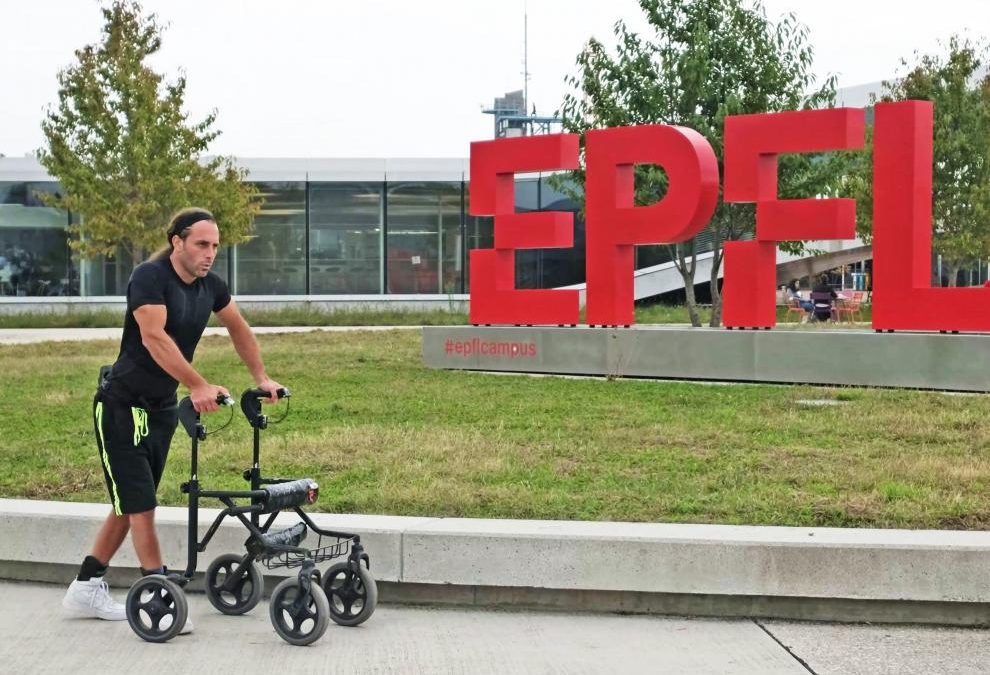
In the Spinal Injury Unit of the Miguel Servet Hospital they value the Swiss clinical trial that has allowed three patients to regain mobility.
A couple of days ago the news went around the world. It seems almost miraculous that three people could walk again and even play sports after suffering a complete spinal cord injury. The scientific advance was published in the journal "Nature Medicine", where it was explained how In Lausanne (Switzerland) three paraplegics have been able to regain mobility thanks to an implant that stimulates the area of the spinal cord that controls the muscles of the trunk and legs.
“The line of electrical stimulation of the spinal cord has been researched for many years. The main novelty is that there has been a technical improvement because it has been possible to find an individualized electrostimulation palette, with an application that incorporates artificial intelligence," he explains. Ricardo Jariod, head of the Spinal Injury Unit of the Miguel Servet Hospital. At the hospital, he and many of his colleagues (not to mention patients) are enthusiastic about scientific progress, but they know that they have to be cautious and remain cautious because, for the moment, it is about an investigation with the results of just three specific patients from a clinical trial that was supposed to be much larger with many more participants. “Another novelty is that the electrode palette must be adapted to each person, which requires individualized treatment, as well as the 'software', which must also be exclusive for each case,” explains Jariod about a very complex technique, which demands a surgical procedure to implant the electrodes at the epidural level, but that opens an immense door to hope.
Professionals the Spinal Injury Unit of the Miguel Servet Hospital They serve and follow up approximately about 1.300 patients. Every year there can be between 60 and 70 new admissions, which are classified into two groups. “There are those who arrive with spinal cord damage of traumatic origin (mostly due to traffic accidents, although there are also work-related accidents or falls); and those who have a medical cause, either due to a stroke that can affect the spinal cord or due to an oncological metastasis,” they explain from the Unit. In all cases it is a devastating injury, so “any progress is hopeful although you also have to know how to put it into perspective,” says Jariod. “It is true that many patients are already asking us and are interested in this technique, but we are in a very germinal moment and It will take years until this practice can be made operational in many of the cases we deal with.", Explain. Not in vain, there are very different profiles of spinal injuries and the three that the Swiss research is showing follow a common pattern: they are young, in good shape, with complete paraplegia and with traumatic injuries.
"It can take years from the discovery of a technique until it can be widely used"
In reaction with enthusiasm and prudence combined in equal parts, it is also happening in the Hospital for Paraplegics of Toledo, which is the national reference when addressing this type of problems and, in the best of cases, rehabilitation. The head of the Service, Dr. Ángel Gil, points out that “the expectation is maximum” and that many of the patients are asking how the aforementioned electrode palette works and if it would be applicable in their circumstances. “We are seeing that there is a path that we have to follow, since "The results achieved are very encouraging."
What research Lausanne It does seem to support, in any case, it is a very promising line of research, “the result of very conscientious work over many years.” The authors of the study They had been working with electrodes in animals for years, then in humans with incomplete spinal cord injuries and, finally, with people who suffered complete sensorimotor paralysis.
The research team, led by bioengineer Grégoire Courtine and neurosurgeon Jocelyne Bloch, had been experimenting since 2014 and four years ago they managed to A young man (David Mzee) who became paraplegic while playing sports began to walk with a walker thanks to epidural stimulation. As they explained, the new technique consists of surgically inserting 16 electrodes in different parts of the spinal cord, which emit synchronized electrical impulses similar to the signals that 'communicate' the brain with the legs through the spinal cord. These electrodes are connected to a computer with artificial intelligence that reproduces the impulses necessary to recover the movements of the lower limbs. Finally, a leadless pacemaker transmits signals to the implant connected to the spinal cord and stimulates specific groups of neurons.
Source: Heraldo de Aragón