
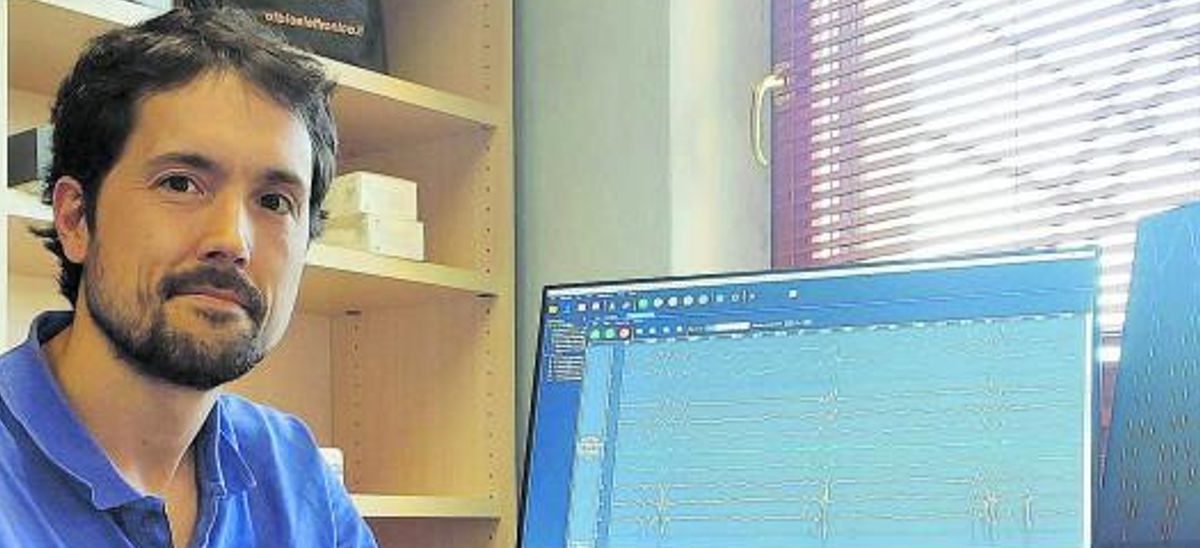
To try to alleviate this situation, Jaime Ibáñez, doctor in Systems Engineering and Computer Science, has launched research with which he is carrying out his postdoctoral degree in the Aragon Health Research Institute (IIS Aragon) with a scholarship from the La Caixa Foundation, and from which Parkinson's patients could benefit (this Monday marks World Day against the disease) and other ailments. The reason? It seeks to "improve strategies for tremor suppression."
So far, The alternatives are "nonspecific drugs with many side effects" or are also being carried out invasive technologies “placing electrodes in the brain” that generate stimuli but also "have many potential side effects"
Nowadays there are also other techniques that are “in the initial phase” which consist of generating microlesions "from ultrasounds but it is unknown if they will have a lasting effect on patients", although, according to Ibáñez, "The results are promising."
The researcher recognizes that many patients "cannot benefit from these techniques" so We must look for "less drastic solutions" like the one he is developing, which "try to interact with the nervous system before it spreads" to the muscles, he points out.
Once it is shown that stimulation in one of these regions "can generate neuromodulation," We will have to try to guide the activity of the nervous system. And this can be done by putting electrodes "near the spinal cord or on peripheral nerves" that have "fewer risks than placing them in the very center of the brain" which can involve other parts of the body.
Six months
To reach these conclusions, the project aims to develop a new non-invasive neural interface in treatments such as "pathological tremor" which is a "bad activity that should not be in the central nervous system" and that is transmitted from the brain to the muscles through the spinal cord," says Ibáñez. TO By processing these biomedical signals of tremors "we can make estimates of what the incorrect activity is like" and look for techniques that stimulate the spinal cord or the brain to "cancel that tremor before it spreads to the muscles."
At the moment Ibáñez collaborates with two universities in London and what they carry out is records with some high-density electromyography devices to "see the activity of the neurons that connect the central nervous system with the muscles." From there, with some stimuli made with some electrodes "at lumbar, neck or scalp level" They can generate electrical currents and produce positive effects to cancel that tremor that appears in the patients' hand or arm.
Currently, he asserts, They are still in the exploratory phase. The next phase will be the development of the closed-loop interface to "identify the source of the tremor" and depending on how it is "determine how I can stimulate to generate its suppression." In terms of deadlines, the project is "three years" and began six months ago.
Having obtained the Junior Leader postdoctoral scholarship from La Caixa has allowed him to "become independent as a researcher," he says, a profession in which Spain continues to "struggle with many shortcomings."





