
A group of researchers generates the first complete sequence without gaps of a human genome
1 April 2022
Tuberculosis is not covid-19, but its vaccines are also urgent
4 April 2022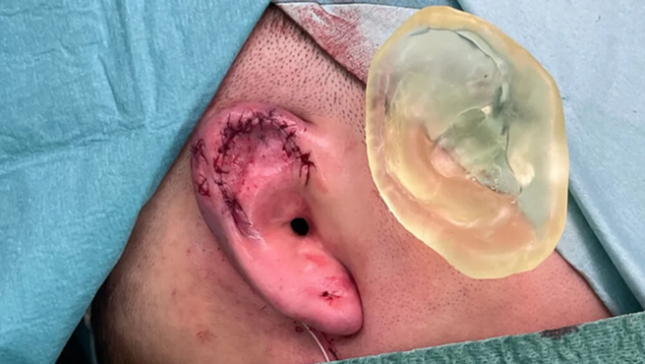
- The Sant Pau Hospital team scanned the patient's healthy ear to create a three-dimensional model. Modeling software then recreated the result.
- The future of transplants is in 3D printers, they will soon print artificial organs compatible with human beings.
The doctors of the Hospital de Sant Pau de Barcelona They have reconstructed a patient's ear with 3D technology. Before intervening in the operation, healthy ear was scanned to create a mold with which the implanted cartilage could be trimmed, in this way, the auricle was restored.
These types of interventions represent a challenge for the medicine due to the difficulty of reconstruction. In this situation, doctors choose the method of implanting a copy with the rib cartilage, thus, the result ends up being flat - in two dimensions -.
Until now, the copies were flat, but More accurate models of the pavilion can be obtained thanks to technology 3D to recreate every detail.
The doctor scanned the patient's healthy ear to create a three-dimensional model, capturing the depth, texture and color of the pinna with a resolution of 50 microns. Subsequently, a modeling software developed the result to print it in 3D
The mold is used to trim the cartilage and make the three-dimensional reconstruction as similar as possible to the other ear.
Hospital sources affirm for NIUS that this entire process “provides greater fidelity to the model than with previous processes based on 2D models and considerably reduces intervention time".
Fuente: 20 minutos





