A young scientist will investigate new therapies for an untreatable hematological cancer thanks to the Medulizar project.
17 July 2026
Registration is now open for the Aspanoa 2026 mountain bike race, which will be held on October 3rd in Almudévar.
22 July 2026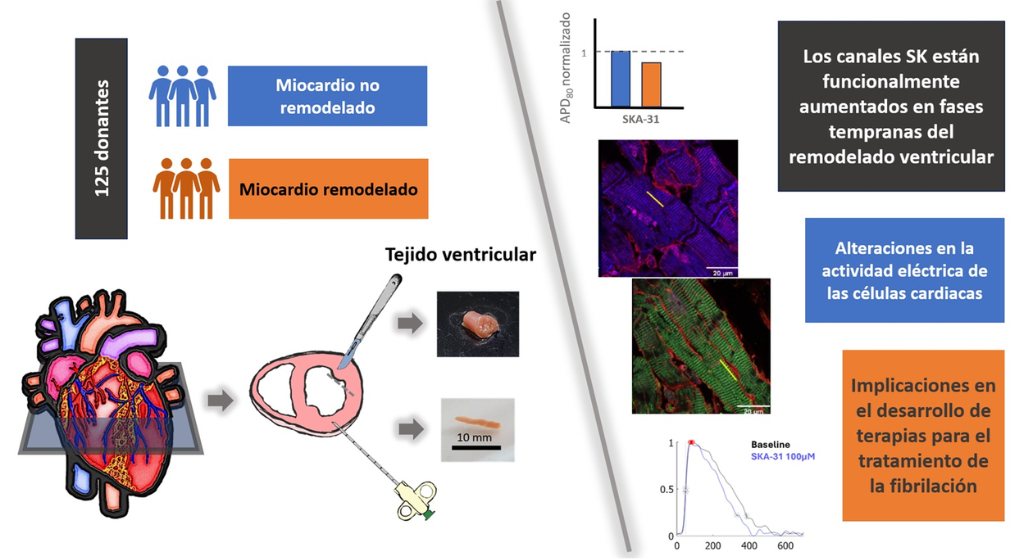
The BSICoS group has analyzed cardiac biopsies from 125 patients in collaboration with the Cardiovascular Surgery team at the Miguel Servet University Hospital
Group researchers Biomedical Signal Interpretation and Computational Simulation (BSICoS)Researchers from the Aragon Health Research Institute (IIS Aragon) and the Aragon Engineering Research Institute (I3A) of the University of Zaragoza have led a study that advances the understanding of the electrical mechanisms of the heart during the early stages of ventricular remodeling.
The study, carried out in collaboration with the Cardiovascular Surgery team at the Miguel Servet University Hospital, has studied for the first time in this type of patient the behavior of what are known as SK channels, proteins that are involved in the regulation of the electrical activity of cardiac cells and that are considered potential targets for the development of pharmacological treatments against certain arrhythmias.
The research was carried out using biopsies of cardiac tissue obtained from 125 patients undergoing cardiovascular surgeryThis has allowed researchers to study these channels directly in human samples and in early stages of ventricular remodeling, a process by which the heart progressively modifies its structure and function in response to different diseases or overloads.
The results show that SK channels increase their functional activity from the earliest stages of this process, even without changes in the expression of the genes that encode them. This finding indicates that their regulation depends not only on the amount of protein present, but also on other cellular mechanisms capable of modifying their function.
The study also provides relevant information for the design and evaluation of new drugs targeting these channels, especially those being investigated for the treatment of atrial fibrillation. Understanding how these channels behave in the ventricles is crucial for assessing both the efficacy and safety of these future therapies and for avoiding potential adverse effects on ventricular electrical activity.
The article, entitled Functional recruitment and regulatory mechanisms of SK channels in patients with early stages of ventricular remodelingIt has been published in the scientific journal Journal of Molecular and Cellular CardiologyThe research is signed by Alba Pérez-Martínez, Cristina López-Andrés, Laura García-Mendívil, Marta López-Yus, Diana Batín, Jose M. Vallejo-Gil, Javier Fañanás-Mastral, Manuel Vázquez-Sancho, Marta Matamala-Adell, Juan F. Sorribas-Berjon, Javier A. Bellido-Morales, Carlos Ballester-Cuenca, Jose M. Arbonés Mainar, Esther Pueyo and Aida Oliván-Viguera.