
Aragonese scientists develop nanocapsules that allow the controlled release of drugs and the destruction of malignant cells through their activation with light
21 March, 2022
The Miguel Servet Hospital reaches the 400th aortic valve implantation without open surgery
21 March, 2022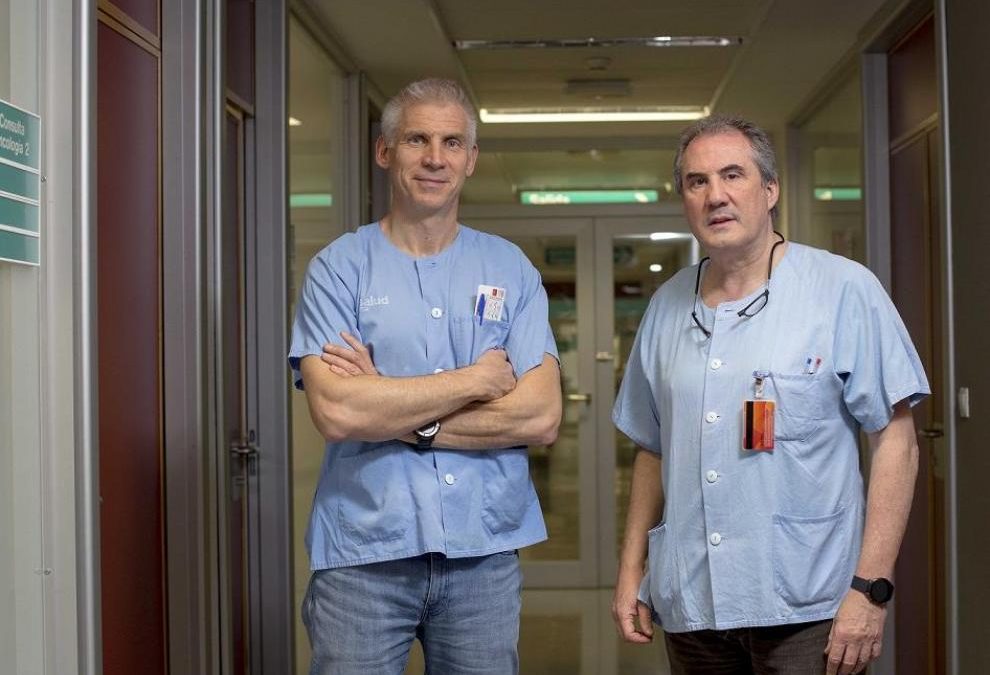
Donations per million inhabitants gradually resume the record path of 2019, with controlled asystole as an alternative with a growing impact on the sector
Javier Paúl is the current coordinator of the transplant area at the Miguel Servet Hospital. Dr. Paúl is one of the center's three hospital coordinators. "In it Clinical There are currently four hospital coordinators, in the Roy Villanova one, in the Bishop Polanco from Teruel there is one and in San Jorge from Huesca, another. We are in charge of evaluating and testing donors, and launching the processes at the required speed.”
Paul remembers that “Spain has been a world leader in organ donations for 26 years. The message of this data is that this country offers the best possibilities to a patient who requires a transplant. In 2019, the last pre-pandemic year and, therefore, with the most representative data to date, Spain registered 49 donors per million inhabitants, a magnificent figure. In 2020 it fell by 23% and the figure became about 37 per million. In 2021 we recovered and returned to 40 per million.”
Raquel Montoiro, regional transplant coordinator in the Government of Aragon, has the same line of thought. “We are gradually recovering the rhythm of our activity, both in terms of donation and transplants, we are getting closer to pre-pandemic numbers, but we are not yet at full capacity, logically. 2019 was a very good year in both segments in Aragon, the autonomous community that grew the most in donations in Spain, and it is difficult to reach those levels of excellence, but I want to emphasize that despite everything experienced in the pandemic, it has never stopped." .
The percentage of refusals
The moment of donation is always delicate, but obviously falls into the traumatic when the donor is a deceased person and your family must make the decision to donate or honor the will of the person who is no longer here. “Our coordination network – explains Dr. Paúl – offers help to people who have experienced a tragedy and want to give meaning to their pain by saving other lives. We talk to them in the middle of the duel, They have lost someone they love after a sudden illness, a stroke or the shock of an accident. Many inevitable feelings come together there, a storm of emotions that accompany the loss, starting with the incomprehension that it entails. There is previous work to raise awareness in society that has made it more open to the idea of donating.”
In Aragon there is another key figure. “In 2019 there was one of the lowest rates of family refusal to donate in Spain: 8%, compared to the national average of 13%. In 2021, that national average is 17%, with Aragon in the same parameters, an indication that what has been suffered socially in the last two years has undermined spirits. Even so, donations have continued to flow, even when family members could not even go to hospitals,” says Paúl.
Controlled asystole is another factor that has boosted transplant activity. “In 2012 - notes Paúl - the law was enacted that allows donation in this patient situation. We are talking about people in ICU who suffer from an irreversible situation; Although the objective is always to safeguard the patient's life as much as possible, when the evidence speaks of zero possibilities of natural survival, artificially prolonging a hopeless situation goes against professional ethics."
A third of current donors in Aragon come from controlled asystole. “Those artificial measures that keep the patient alive are removed, and if five minutes pass without the heartbeat recovering, another surgical procedure and a new support system are put in place to make a donation of their organs effective. In Aragon the Clínico was the first hospital to do so, and the Servet followed; In 2021 there were seven cases in our hospital. This technique has been greatly improved by adding ECMO or extracorporeal circulation support, to optimize all factors. “We are practically at the national average with that third of the total cases.”
Paúl points out that “the pandemic has been a tragedy in many ways, including the limitations in care. We have always asked society for generosity in donations, but in 2020 and 2021 that generosity was reversed; They asked the transplant programs not to use beds to give more space to the ICU when treating the most seriously infected. This second level produced the logical drop in donations, and in 2020 Aragón moved to the bottom in this chapter; We improved in 2021, reaching 30 donors per million, and in 2022 there is already a clear improvement, we are very close to the national average.” Last year, Aragón was also above the national average in multi-organ donors.
Kidney and heart transplants are performed in Servetus; In the Clinic, liver tests are performed. “In addition to that, we have as a reference the Clinic of Barcelona for kidney-pancreas transplants, a modality in which about 80 procedures are performed a year in Spain. For lung transplants we refer to Madrid and Barcelona. Tissue donation also seems key to me, many patients benefit from it in Aragon; lThe donation of corneal tissue, for example, often saves its recipients from blindness; The same thing happens with bone tissue to be able to reconstruct the affected area after severe trauma, an infection, a tumor… several people can benefit from a donation,” says Paúl. In Servet, by the way, 2.000 transplants were recently exceeded; the first was on June 6, 1986.
living donor
Dr. Alex Gutiérrez Dalmau is in charge of the living donor transplant program at Servet. “We started doing it here in December 2007, and around 110 have been done so far. The benefits of receiving an organ from a living donor are multiple, and not just for the transplant; It must be taken into account that it leaves a free spot on the waiting list and one more organ available for those who do not have a living donor. Definitely, it is the best treatment option we can have in very serious kidney failure, since the transplant can be done at the most appropriate time, when the degree of the disease demands it; “It is the organ of a healthy person with normal kidney function.”
Gutiérrez Dalmau remembers that there is a consultation specifically dedicated to donation. “The priority is that the risks inherent to the process can be minimized; A multidisciplinary team intervenes to evaluate the donation that includes psychiatry, the psychosomatics unit and, in short, an evaluation external to nephrology and the universe of transplants, to have a literally disinterested point of view in the transplant program; Of course, there is an assessment of urology, nephrology and anesthesia in the procedural aspects. The goal is for the donor to act with guarantees of a risk threshold accepted as low, and that your decision is completely free; "You must understand that beyond the risk of a complex surgical process in the short term, you think about your long-term safety, the quality of the rest of your life."
Dr. Gutiérrez recalls that in the hardest months of the pandemic, the transplant from a living donor had another advantage over that derived from a donation after death. "We were able to suspend some to safeguard safety according to the epidemiological moment and the results in this regard have been very positive, since we were able to maintain the activity, although logically the pace suffered."
Gutiérrez closes his speech with an explicit wish. "Now we need support from Health in which we certainly trust; It is about streamlining pre-transplant studies and increasing the availability of resources for everything that this program entails., because many evaluation visits are needed, complementary tests... the waiting lists caused by the pandemic can negatively impact the process. Luckily, the feeling is that activity is recovering, we have already had two transplants this year and there are several more scheduled before July, which brings us closer to the high rates per million inhabitants in Spain.
Source: Heraldo de Aragón





