

Sport, for physical and mental health
1 February, 2022
Marilourdes de Torres: «Hospital menus are a combination of science and imagination»
1 February, 2022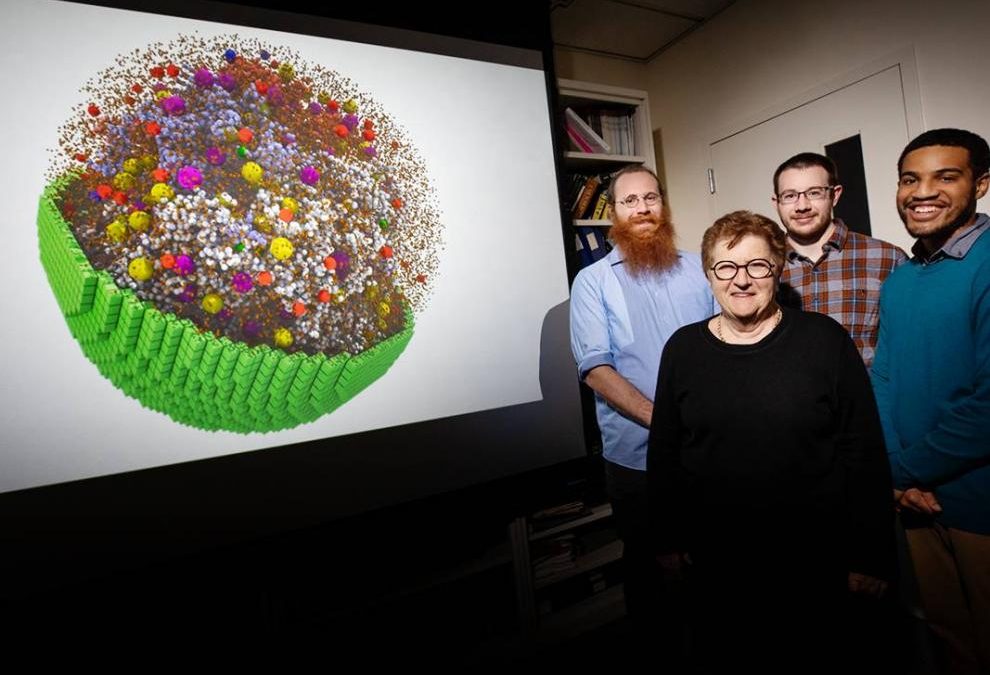
US researchers have developed a kinetic, three-dimensional and fully dynamic model that imitates what happens in a real cell. The results offer insight into the fundamental principles of life.
A scientific team led by the University of Illinois Urbana-Champaign (USA) has built a living mini-cell with a genome reduced to the most essential, and a computer model of the cell that reflects its behavior.
The authors of this work, which is published in the magazine 'Cell', point out that are developing a system to predict how changes in genomes, living conditions or the physical characteristics of living cells alter their functioning.
“Minimal cells have reduced genomes that carry the genes necessary to replicate their DNA, grow, divide and perform most of the other functions that define life,” says Zaida (Zan) Luthey-Schulten, a chemistry professor at the American university, who has led the work with graduate student Zane Thornburg.
The simulation developed maps the precise location and chemical characteristics of thousands of cellular components in 3D at the atomic scale. You can know how long it takes for these molecules to diffuse through the cell and find each other, what type of chemical reactions occur when they do so, and how much energy is needed for each step, the university explains in a statement.
To build the minicell, researchers from the J. Craig Venter Institute (JCVI) in La Jolla (California) They turned to the simplest living cells: mycoplasmas, a genus of bacteria that parasitize other organisms.
In previous studies, JCVI scientists built a synthetic genome which was missing as many non-essential genes as possible and they cultured the cell in an environment enriched with all the nutrients and factors necessary for its maintenance.
In the new job the team He added back some genes to improve cell viability. This is simpler than any natural cell, so it is easier to model on a computer.
Data from decades of research
According to Luthey-Schulten, “The simulation of something as complex as a living cell is based on data from decades of research”.
To build the computational model, she and her colleagues needed to take into account the physical and chemical characteristics of the cell's DNA, lipids, amino acids, and the gene transcription, translation, and protein-building machinery.
Also They had to model the way each component spreads through the cell, keeping track of the energy needed for each step of the cellular life cycle. NVIDIA graphics processing units were used to perform the simulations.
“We built a computer model based on what we knew about the minimal cell, and then we did simulations,” explains Thornburg, “and “We also checked if our simulated cell behaved like the real one.”
The simulations allowed the researchers understand how the real cell “balances the demands of its metabolism, genetic processes and growth”, notes Luthey-Schulten.
What do cells use most of their energy for?
For instance, The model revealed that the cell used most of its energy to import essential ions and molecules across its cell membrane. “This makes sense,” says the researcher, “because mycoplasmas obtain most of what they need to survive from other organisms.”
These simulations also allowed Thornburg calculate the natural lifespan of messenger RNAs, the genetic blueprints for building proteins. They also revealed a relationship between the rate of synthesis of membrane lipids and proteins and changes in membrane surface and cell volume.
“We simulated all the chemical reactions inside the minicell, from its birth to the moment it divides two hours later,” Thornburg details, “and from there, “We achieved a model that tells us how it acts and how we can make it more complex to change its behavior.”
Luthey-Schulten insists that his team has developed “a fully dynamic, 3D kinetic model of a living minimal cell, opening a window into the inner workings of the cell.”, showing us how all components interact and change in response to internal and external signals.”
“This model—and other more sophisticated ones to come— "It will help us better understand the fundamental principles of life.", concludes the researcher.
Source: Heraldo de Aragón





