
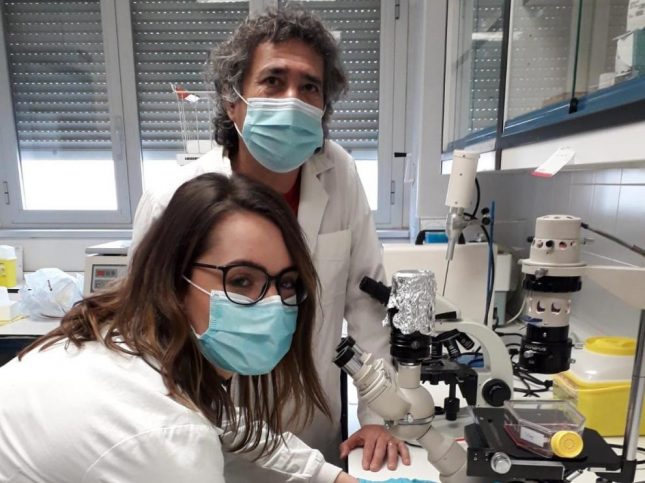
The University of Zaragoza develops an antitumor against bone metastasis with a US company
23 December, 2020
The 'special' Christmas of Pisón and other Aragonese references: No celebration in Zaragoza and "hangouts" in the park
23 December, 2020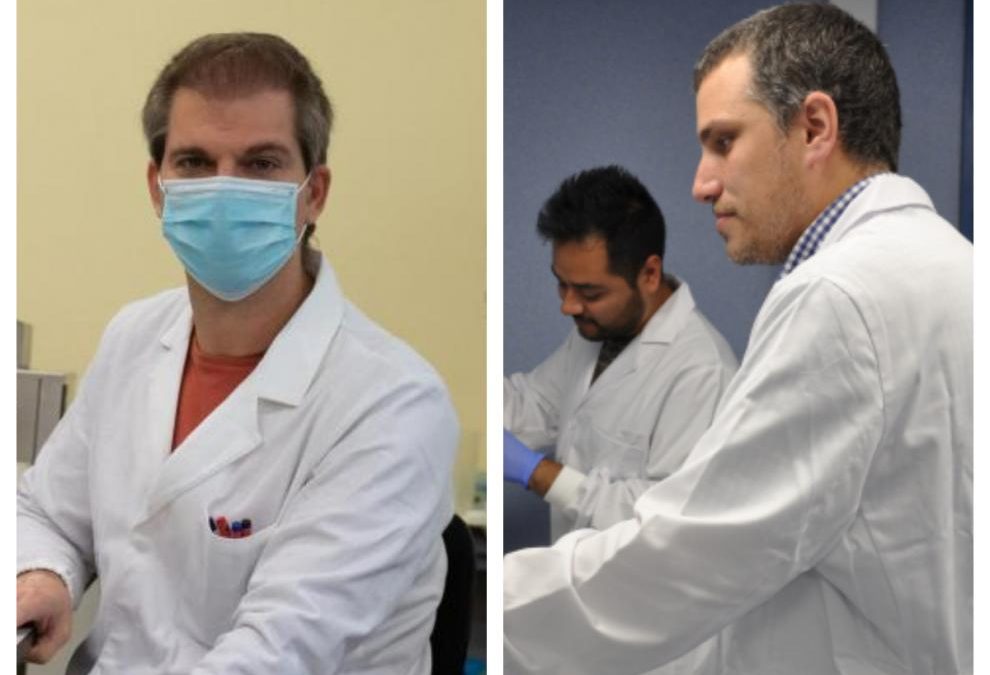
The genetics researcher at the University of Zaragoza Jesús Gonzalo-Asensio and the Genomics expert Iñaki Comas agree that the vaccines will be effective with the new variant.
The new strain of coronavirus detected in the United Kingdom has raised all alarms. This variant of SARS-CoV-2, in principle more contagious, is spreading across the islands and has already made the leap to the European continent. It is one of the hundreds of mutations that the virus has had, but its rapid expansion has attracted attention and caused a chain reaction at all levels, at a time when vaccines seem to anticipate the beginning of the end of the virus. In Aragon and Spain the new strain is not yet there (or at least it has not been detected), but it is expected.
Jesús Gonzalo-Asensio, biochemist from the Microbacterial Genetics group at the University of Zaragoza, sends a message of “tranquility and calm”, but also of “caution”. He explains that viruses “usually undergo mutations,” since these are “the mechanism that allows them to evolve.” But those mutations don't have to make them more dangerous. In fact, in the case of SAR-CoV-2, at the moment “it has not been shown that there is any more lethal or more virulent than another.” The one that emerged in the United Kingdom, neither.
"There are reasons for concern, but not for alarmism." Iñaki Comas
Iñaki Comas, one of the greatest experts in Genomics in Spain, tells HERALDO that what makes this variant different is “that it has a combination of mutations that we had not seen until now.” These mutations affect “the part of the virus that interacts with us,” but “what it does and what it does not do” is still unknown. Therefore, he asks for patience until the studies progress. “There are reasons for concern, but not for alarmism,” he summarizes.
Gonzalo-Asensio also warns that it remains to be seen whether it has a greater transmission capacity. “It is possible, but we have to wait for the trials to confirm it, because its expansion could also have been due to some episode of super-dispersal in the south of England,” he points out. Comas points out that “the number of mutations it has gives us a certain signal that we are probably facing a more transmissible strain,” but also asks for caution because “it is being studied.”





