
II Edition Award for the best Doctoral Thesis in Medical Imaging and Genomics _ QUAES-UPV Foundation Chair
November 5, 2021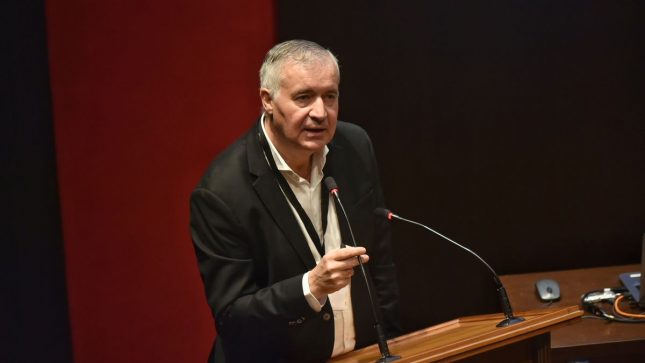
Javier García Campayo: «Happiness and suffering are within our minds»
November 5, 2021
Pediatricians explain how to prevent it and emphasize that the majority of cases are "self-limited" and with "good" evolution.
According to sources from the department of Health, this type of acute gastroenteritis outbreaks They are relatively frequent at this time of year and, in fact, "they have already appeared in previous bulletins", although these reports do not detail which virus caused them. "We have been seeing viruses since schools and daycares started. Some weeks it's more gastroenteritis, others it's respiratory... but it's continuous. This WeekIn particular, it has caught my attention that there have been more cases of gastroenteritis, But stool culture is not performed for its approach because it is not necessary. It is interesting when the outbreak is a restaurant and there may be a germ transmitted through food, but if it is not a specific outbreak in a residence or daycare, or when you see that it lasts for many days, it is not necessary to do tests because it gives you "It may be one virus or another that causes it, since the treatment and evolution will be very similar," the doctor clarifies. Teresa Cenarro, president of the Aragonese Association of Pediatrics of Primary Care.
Stool cultures to give a "name and surname" to the virus
Pediatricians remember that Most of the gastrointestinal processes that are being seen in children are "viral and self-limiting conditions", which explains that most of the time it is not necessary to carry out coprocultures (laboratory tests that allow us to give names and surnames to these viruses).
"There are many more children who have to be immunized, going through the infectious processes typical of childhood"
In his consultation, as the incidence of coronavirus has been reducing, the presence of this type of virus. "This year cannot be compared with the past, because everyone disappeared. But if we compare with the last pre-pandemic year, the general impression is that there are more viruses, which makes sense because there are a greater number of children likely to pass the processes: those who had it last year and who were not caught, and those from this year. There is a much larger child population that has to be immunized by undergoing the infectious processes typical of childhood."says this doctor, who for the peace of mind of the families downplays the importance of this type of condition.
"The majority of viral processes that we are seeing are self-limiting, with short incubation periods and what causes vomiting y diarrheal stools in all people, but especially in Small children, which is usual," she details. This doctor recognizes that the sapovirus, which takes its name from the first outbreak detected in the city of Sapporo, "is very contagious," like the rest of gastrointestinal viruses. Its incubation period is short and It causes symptoms for 3 to 5 days (except in small children and the elderly, which can last longer).
At the moment, in Zaragoza, the president of the Aragonese Association of Primary Care Pediatrics unknown that there has been an outbreak of acute gastroenteritis caused by sapovirus, although he insists that thanks to the improvement of diagnostic tests, many viral processes that were not detected before are now diagnosed. "The same thing happens with the detection of parasites: microbiological techniques have improved a lot and thanks to this we give names and surnames to gastrointestinal processes. Although In the case of viral processes, the evolution is good and it is not usually necessary to request a stool culture."he emphasizes.
How to prevent viral infections
To prevent this pathology, Dr. Cenarra advises keep hand washing in mind, which is "very important" to avoid the spread of gastrointestinal viruses. "Both in children who have infection and in those who care for them and they change, for example, their diapers," concludes this pediatrician.





