

Laughter, a tool for diagnosing depression
August 14, 2025
Aragon promotes personalized medicine with two projects to improve genetic diagnosis.
August 25, 2025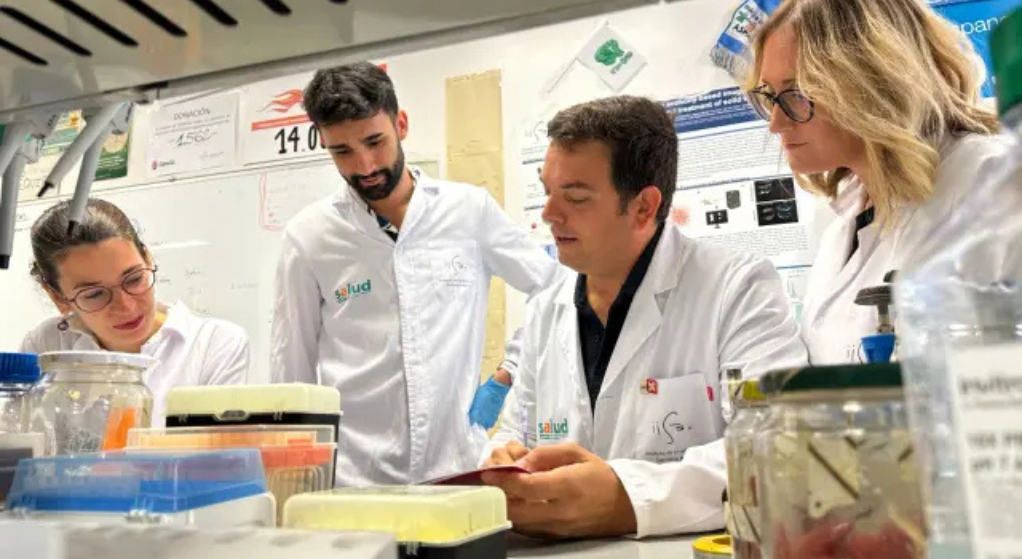
Developed by the Molecular Oncology Group at the IIS Aragón, led by Alberto J. Schuhmacher, it is based on an innovative technology that uses nanobodies derived from dromedary camels. We share the latest report on the project, just published by Heraldo de Aragón.
In the laboratory he directs Alberto J. Schuhmacher, ARAID researcher and head of the Molecular Oncology Group from the Health Research Institute (IIS Aragón), all the projects they are involved in They have a person's name. And this is because for this Zaragoza native, who has spent years searching for new diagnostic methods and treatments against the most lethal tumors, ""All science must have a social purpose or it is not science." That's why a project related to sarcoma is called 'Celia,' and the one focusing on male breast cancer is called 'Antonio.'
His latest work, 'Sara', promoted by the IIS Aragón and financially supported by the Ibercaja Foundation, commemorates a beloved person in this institution, who has since passed away. She is the source of inspiration for this work. innovative project of oncology research what are you looking for the most effective way so that the nanobodies responsible for transporting the chemotherapy drug to the tumor cells do so without damaging healthy tissues and without causing so many side effects.
«In this technology we use nanoantibodies, which are antibody fragments smaller than conventional ones, derived from dromedaries. They are responsible for adhering to tumor cells, releasing the chemotherapy drug inside them without harming healthy cells. Any compound that doesn't stick to the tumor is quickly eliminated through urine. which improves the effectiveness of the treatment and will reduce its toxicity," indicates Alberto J. Schuhmacher.
Initially, the research began working on brain tumors because Alberto J. Schuhmacher, in his early days, focused his work on this area, first in the United States and then in Madrid. "In these tumors, we identified therapeutic targets (specific molecules that are important for the growth, survival, or dissemination of cancer cells) and We saw that they were also present in other very aggressive types of cancer. "This is why we are now making progress in sarcomas, metastatic breast cancer, male breast cancer, and many other tumors," adds Marta Baselga, a postdoctoral researcher.
fewer side effects
The fact that chemotherapy affects only the tumor and nearby cells, without damaging healthy tissue, and is eliminated so quickly is very beneficial for patients, who "They could thus see a reduction in the side effects of chemotherapy, which is sometimes very harmful. Schuhmacher clarifies, recalling that "currently, there are very aggressive drugs against the tumor that, however, They cannot be used because they would be excessively toxic to the body. Thanks to this compass chemotherapy, they could be administered because they would attack exclusively the affected part.
"Currently, there are very aggressive drugs against tumors, but they cannot be used because they would be excessively toxic to the body.
In this regard, oncologist Víctor Manuel Medina Pérez, who is part of the research team, points out that "when a patient receives chemotherapy, tumor cells are eliminated, but also cells from other parts of the body that are multiplying, such as hair or some cells in the intestine or skin, hence the side effects include hair loss, intestinal disorders or skin sensitivity. More than 90% of the chemo given to a patient doesn't reach the tumor; a much smaller percentage does.
From the laboratory to the patient
Until the 'Sara' project can be applied to patients, it will take years, at least five, because as Schuhmacher points out, "one thing is what we do in the laboratory, which we can produce on a small scale and test in experimental models (mice or other animals), and another thing are all the necessary steps that must be carried out to protect that research intellectually and ensure that it can reach a patient through trials to confirm that it's safe. All of this without forgetting the collaborators needed to get it out."
While this is happening, many people are involved in the research, both directly (eight researchers) and indirectly, since They have many collaborations with clinical oncologists, staff from other laboratories and other professionals, up to fifty.
"Today's technologies and advances will be tomorrow's medicine."
And everyone works with the conviction that "Today's technologies and advances will be tomorrow's medicine." For this reason, through the Aragón Health Research Institute, they collaborate with hospitals not only in Aragon, but also in other parts of Spain and around the world.
«Science is global And that's why we have the support of Belgian groups, who discovered this type of antibody; of Americans, who have binders to special chemotherapy; and also of Japanese. The structure of the Aragon Health Research Institute allows for this collaboration between those of us who "only" conduct research and those who care for patients on a daily basis. "This way of doing science is very enriching." concludes.
Source: Heraldo de Aragón





