
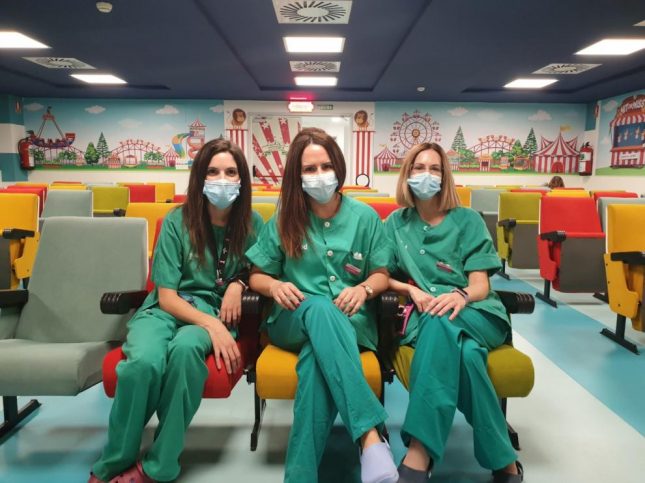
Nurses from the Children's Hospital launch a pioneering study in Aragon to reduce anxiety in children who are going to undergo surgery
20 December, 2021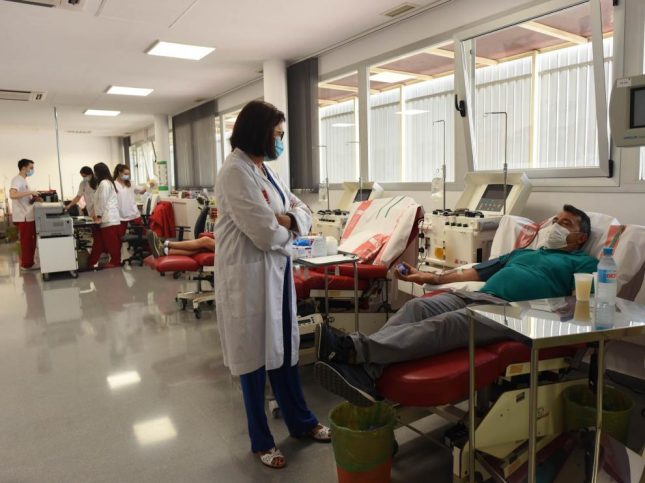
Blood Bank: "We appreciate the citizen response, but we need more donations"
21 December, 2021
More than ever, family, friends or colleagues tell us “I tested positive” or “so-and-so has tested positive” or “there was a positive in my daughter's class.”
Official covid transmission figures are growing rapidly, until they equal (and will probably surpass in the coming weeks) those of previous waves.
Fortunately, The high vaccination figures achieved, especially in those over 60 years of age, make the situation of hospitalizations and deaths – at least for the moment – less serious. than in previous waves.
Fortunately, most of the time – although not always – these messages are accompanied by “calm down, I'm fine.”
It is more than possible that there is much more transmission than we are able to detect. Many asymptomatic or paucisymptomatic cases do not seek medical attention. Many vaccinated people, even if symptomatic, attribute their symptoms to colds or other minor illnesses and do not undergo diagnostic tests.
Others (positive in a public sale antigen test or close contacts) cannot contact primary care services that, despite their efforts to respond, are overwhelmed between vaccinations, performing PCR, monitoring of positives, contact tracing and maintaining care for the most complex patients.
While hospitalizations saturate hospitals, infections – even if most are mild – overwhelm the response capacity of primary care. These cases do not exist in official statistics either.
In this article we try to give some ideas on how to act in these situations. In general, although not always, they coincide with the latest version of the document 'Strategy for early detection, surveillance and control of covid-19' from the Ministry of Health. And they are suitable in many general situations, but not for some specific situations (residences, schools, prisons, health centers or others with vulnerable people, etc.) that require specific management.
Forget the idea that since you are vaccinated or have had Covid, it will be a cold or another viral illness. Act as if you were positive (isolation) until covid is ruled out with a diagnostic test
What to do if I have symptoms compatible with covid-19?
Forget the idea that since you are vaccinated or have had Covid, it will be a cold or another viral illness. Act as if you were positive (isolation) until covid is ruled out with a diagnostic test. If possible, contact your health center (normally they will give you a date and time for a PCR). If this is not possible, pharmacy antigen tests (performed according to the manufacturer's instructions) are very reliable in symptomatic people.
Suspected symptoms (more than one usually appear) may be the presence of fever or chills, cough, difficulty breathing ('shortness of breath'), fatigue, headache, muscle pain, (recent) loss of smell or hearing. taste, sore throat, nasal congestion ('runny'), nausea or vomiting and diarrhea.
Difficulty breathing is the most worrying symptom and requires urgent medical consultation for evaluation. You should also seek urgent care if you have persistent chest pain or pressure, confusion, or pale or bluish color to your skin, lips, or nail beds.
What to do if I am positive in an antigen test sold in pharmacies?
Start isolation. Wear FFP2 mask. Contact your health center. You will probably be scheduled for a PCR test and will be given instructions based on your symptoms.
Isolation must last a minimum of 10 days from the onset of symptoms (or the date of the test for those who are asymptomatic), although if symptoms persist, isolation could be prolonged. Put aside those false ideas that those vaccinated, those who have had Covid-19 or children do not or cannot be infected. Strictly adhere to isolation.
In most cases, the symptoms are mild and do not require intensive follow-up by primary care. But if you have difficulty breathing or any of the symptoms mentioned above, contact a health service as soon as possible.
Infections can occur anywhere (not just in restaurants, nightlife or in crowds). Also at work, in sports activities, teaching, worship, etc.
It is very likely that your cohabitants have been infected. They are contacts, more than close, very close. Also those people with whom you have recently shared the air you breathe (especially in the last two days). Warn them. Even if they are vaccinated or have had covid-19.
Infections can occur anywhere (not just in restaurants, nightlife or in crowds). Also at work, in sports activities, teaching, worship, etc. The possibility of contagion is higher if the encounter took place in closed, poorly ventilated spaces, without a mask, in close proximity and was prolonged. Prepare a list with telephone numbers of your contacts to help tracers.
What to do if I am a close contact?
Even if you have been infected, diagnostic tests, including PCR, will not give positive results until 3-5 days after contact with the person who infected you. If you are not vaccinated, you should isolate yourself and try to contact the health services to perform a PCR (usually you will be summoned around the 5th day from the date of contact with the person who potentially infected you).
Taking a test beforehand (unless you have symptoms of Covid-19) is of little value and a negative result does not allow you to lift isolation. If the test on the 5th day is negative, the isolation can be lifted.
If you are vaccinated you should do exactly the same as if you are not. Currently, the Ministry of Health does not require the isolation of vaccinated close contacts (although some Autonomous Communities do) and only recommends reducing encounters and avoiding contact with elderly and vulnerable people. But this is a recommendation based on initial studies after vaccination. When the immunity provided by vaccines was recent, the predominant variant was not delta and omicron was not spreading.
This mismatch between the current situation and the recommendations of some health authorities can complicate obtaining sick leave due to isolation. Even with this complication, which will probably be resolved shortly, workers and employers should avoid exposing themselves to a –predictably more damaging– outbreak in their company.
Let us remember that the viral loads of the vaccinated infected are similar to those of the unvaccinated and that, as far as we know, ómicron notably increases the risk of gap infections (in vaccinated people) and reinfections (in people who have previously suffered from covid-19 ).
What to do if I have no symptoms and I am not a close or positive contact?
What should anyone do in such a high transmission situation? Basically, reduce as much as possible the risk of being a case or close contact of a case. This has two components: distrust the myths and legends that circulate everywhere and act by avoiding at least the highest risk situations.
First of all, neither Covid-19 has turned into a cold (although many people will only suffer mild symptoms), nor can those vaccinated – or those who have had Covid-19 – become infected or spread it (although they probably do so somewhat). less).
Currently, vaccination or having had Covid-19 (and, above all, both) maintain protection against the risk of developing severe Covid-19 (having to be hospitalized or dying). But not completely. And probably a little less the greater the distance from vaccination. And probably less so with the expansion of omicron.
Much transmission will lead (already does) to the overflow of primary care. And many patients – Covid-19 and, above all, non-Covid-19 – will suffer the consequences. Furthermore, if the infection numbers are high, they will also saturate hospitals and make it difficult to care for the most serious cases (covid and non-covid).
And if we approach the limit at which we can no longer adequately care for the most serious cases, Harsh restrictions – as the Netherlands now imposes, with hospitalization, ICU and death figures much higher than those of Spain – will be inevitable. And the restrictions will increase the poverty and unhappiness of many people and, of course, social unrest, the unrest of everyone.
These are festive times, but also the time to reduce our meetings. If you can avoid contact, of any kind, avoid it. If you can't, better outdoors. If it cannot be outdoors, better in well-ventilated areas, and maintaining distance and a mask. whenever possible. Whether you are vaccinated or not. Whether they require a covid-19 passport to enter or not. Whether you have had antigen tests or not.
And when you can, and especially if you are over 60 years old, go for your third dose. Don't put it off. It's not the moment.





