
"Women claim their important role in science"
11 February, 2022
Carlota Calvo: "Children who face cancer teach lessons to us adults"
14 February, 2022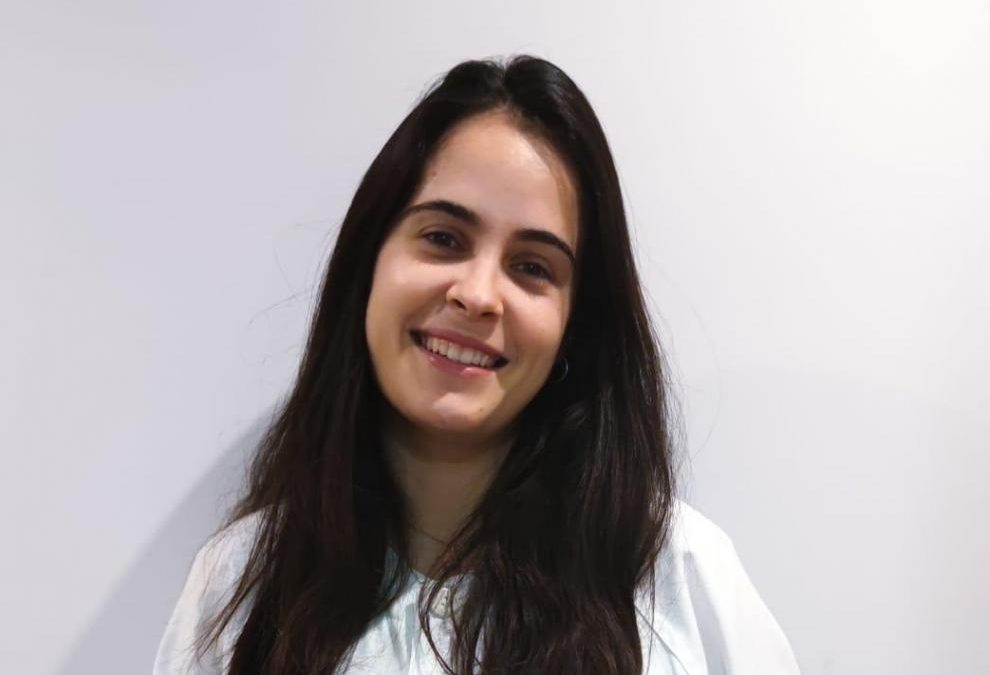
The 28-year-old healthcare worker, who works at the Clinical Hospital, has won the XXXVII edition of the contest with the research "Adverse events during the cleaning of neurocritical patients."
During a regular work day in a Traumatology ICU, nurse Paula Betés noticed that, after cleaning the patients, most of them neurocritical, Many of them experienced adverse effects that destabilized their general condition. So he began to study how to avoid them, and concluded that preventive measures such as modifying ventilatory parameters, administering vasoactive drugs and sedation, and increasing the time allocated to the daily hygiene process helped the patients' well-being. He captured all of this in his master's thesis, which he titled 'Adverse events during the care of neurocritical patients' and which has earned him the recognition of the National Nursing Award of the City of Seville, a prestigious competition organized by the College of Nursing of the Andalusian capital that is now in its thirty-seventh edition, and that recognizes the research work or unpublished monographic studies of these healthcare professionals.
The most important thing of all for Paula, she says, is that she receives applause from her colleagues: “I am proud and happy because this type of studies requires perseverance and effort, and It is a plus that the nurses themselves are the ones who evaluate and assess it"says this 28-year-old girl, born in Tauste and who currently works in the Anesthesia service of the Zaragoza Clinical Hospital. She presented the work because she had the opportunity to feel recognized through it and because at the time she already achieved a good grade and the coordinators of her master's degree told her that she was very good, but she admits that she " "I didn't expect to win." “I don't know if she will have more significance, beyond the fact that Publishing jobs scores us, and that adds up when it comes to taking a competitive exam or opting for a contract.", he adds.
Her colleagues at the Clinic are gradually finding out about the recognition achieved by this young woman from Cincoville, and they begin to congratulate her after reading the news in the newsletter of the Zaragoza College of Nurses or on some of the Cinco Villas websites. But she humbly acknowledges that she is not telling it around. “I have been in the hospital since October, first in vascular surgery and since February 1 in anesthesia. I don't have enough trust with my colleagues, although today the director of nursing called me to congratulate me,” he explains.
"I'm going to work and I don't think it's a sacrifice"
Devoting herself to caring for others has been on Paula Betés' mind for as long as she can remember. “Since I was very little I like to worry about the well-being of those around me. I am very curious about the health of people close to me, and I always knew I wanted to dedicate myself to something related to health.", account. Already in the 4th year of ESO he focused on nursing, and he has never regretted his decision. What does he like the most? “I'm going to work and I don't think it's a sacrifice. For me, it is very rewarding to help people improve their quality of life, I am happy in my work,” he explains. Even in these difficult times that we are experiencing due to the covid-19 pandemic: “Even though things look hard, I always have something positive and human to tell when I return home,” he says.
A survey by the General Nursing Council published this past Monday reveals that almost half of Spanish nurses have at some point thought about leaving their profession due to the physical and mental exhaustion suffered during the health crisis, and a third would not choose these studies again. Among other results, it stands out that more than 84% of professionals have been affected on an emotional and mental health level, especially those who work in ICUs - where there is a much higher mortality rate than in other areas -, followed by those in emergencies and primary care.
In this sense, Paula Betés assures that she forgets bad things “soon” and always tends to stay with the positive, although when the pandemic began, almost two years ago, I worked in the emergency department of the Royo Villanova Hospital and there he lived, as in the rest of the hospitals in the country, a heavy workload that made him go home "exhausted and with great anxiety because of the lack of knowledge of something so new.” The workers at that health center had the opportunity to participate in therapy groups to learn how to handle the situation, and there she was able to vent and talk to her colleagues, in order to feel “understood.”
However, what makes her most “angry” is how, in her opinion, contracted health personnel, like her, have been treated. “When they need you, when there is a pandemic, they hire you, but when you are no longer useful they kick you", he complains. Without taking into account, she affirms, “that we have been there, in the worst moments, giving our best, and knowing that we will also be there when they need us again.” Thus, denounces the “great work overload” that these professionals have been experiencing since long before the health crisis of the coronavirus.
Source: Heraldo de Aragón





