
The sixth edition of the Multidisciplinary Innovation Award of the SAMCA Chair of Technological Development of Aragon is underway.
21 July 2025
Aragonese researchers design nanoparticles that evolve in the tumor environment, generating two different therapies successively.
22 July 2025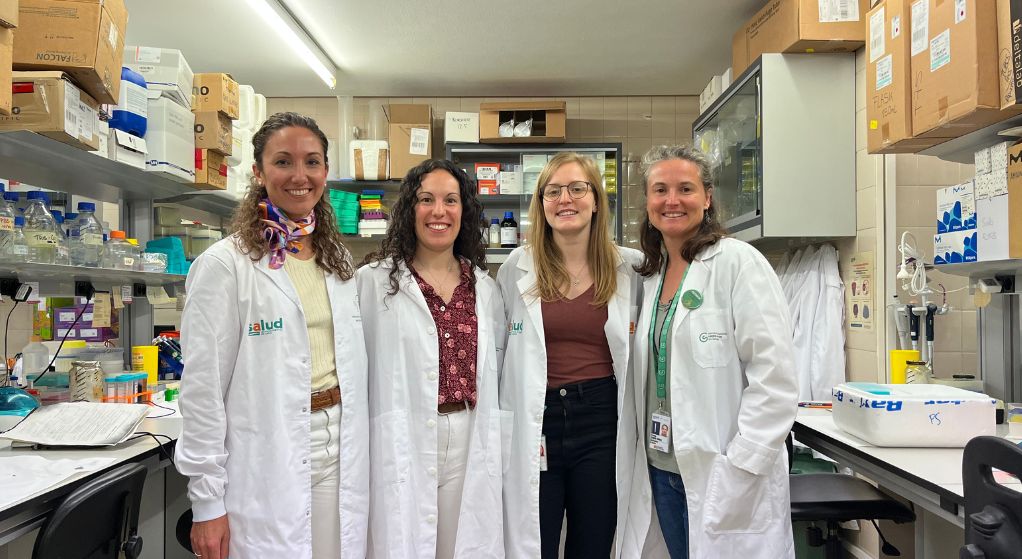
The IIS Aragón scientist leads the study that has discovered a new way to slow the spread of pancreatic cancer. We share this interview in El Periódico de Aragón
The group you lead at the IIS Aragón has just discovered a new way to prevent pancreatic cancer metastasis. How did you achieve this milestone?
We've identified a previously discovered protein and given it a new function in pancreatic cancer. This protein detects when tumor cells are experiencing environmental stress—that is, when they lack sufficient oxygen, nutrients, or are not in adequate conditions. It then activates and sends a signal, saying, "Let's go seek out other horizons with more favorable conditions." The cells change shape and can migrate to other sites in the body, creating new metastases.
What we've done is test two drugs designed to block this protein in laboratory cells and experimental mice. We've seen that with these drugs, which are experimental and not used clinically, we can significantly slow this metastasis.
Never before has such a breakthrough been achieved…
It's very novel, yes. This has been discovered in other types of cancer, but it even generated opposite effects. There's been much discussion about how it works, because ultimately, the same protein can function differently in different types of cancer.
You mention that these are experimental drugs. When could this study be carried out on the patient?
There's still a long road ahead to try to validate these inhibitors and bring them into clinical use. Many of the drugs we're working on in animals can't easily be transferred to humans due to their properties. Funding must be allocated to study compounds that perform the same function as these drugs but can be used in humans.
What is the main challenge to address in pancreatic cancer?
One of the main problems is that it's diagnosed very late, in very advanced stages, so by the time it's found, there's already metastasis. The priority is to try to diagnose it early so that the appropriate drug can be applied and effective. If metastasis is already present by the time it's diagnosed, there's nothing we can do even if we have the drug.
And has there been progress in early detection in recent years?
Everyone has seen the value of early diagnosis of pancreatic cancer. The problem is that the symptoms are very general: back pain, general malaise... It's not easy to detect. But significant resources, both in terms of people and funding, are being allocated to early diagnosis. This is the goal we must gradually achieve.
Research takes time. When did the study begin?
I started in England in 2015. Then I brought it to Zaragoza and hired Bea Parejo. We started working together in 2018 and have been working ever since.
You are four female researchers from Aragon. That's also worth highlighting.
This project is a source of immense pride for us. My research group is 100 percent made up of women, and I believe these achievements can be a way to promote the role of women in science and serve as a reference for other researchers: quality science is produced regardless of whether you're a man or a woman. That's why we want to promote it a lot, to see a photo of women in a study that has been published in a prestigious international journal.
But there are still major challenges for women in science.
Yes. Almost more women than men start out in research, but we're losing them along the way. Few end up in prestigious positions. What's happening? Why is there this gap?
How can that be changed?
There's a lack of awareness and policies that help foster work-life balance so that a woman doesn't feel that, if she has a child, she can no longer apply for a position of responsibility in science. I had a daughter and had to put that aspect aside somewhat until my scientific career was well underway. I've had to delay my family life to pursue a professional-level research position, and I think there's a lack of supportive policies to make it possible to do both at the same time, because it's not impossible.
And your case is not the only one.
Both Beatriz, the author of the study, and I are mothers of young children. We were able to do this study, but not without sacrifice. We've been balancing our work and family life for years.
Have there been critical moments?
It was difficult to launch because at first we were a small group, just Bea and I. When I started, I was pregnant, and while I was on maternity leave, I didn't disconnect from the lab.
And on an economic level?
We've been fortunate because various foundations have recognized the value of what we were doing, especially the Spanish Association Against Cancer. Bureaucratically, it's been more complicated because I started the research in England, and bringing the materials to Spain was a bit daunting. We also had some problems with the previous institution because, in terms of intellectual property, they wouldn't let us bring all the research here. There was a time when we had to halt the project, but we finally resolved it through negotiations.
The project was carried out with international collaboration.
In total, 27 different countries participated. That was another challenge, because coordinating so many people is difficult. There were a lot of us, and communication is obviously less fluid. The science behind the project was clear, and what was more difficult was the surroundings.
In the end, everything has come to a good end.
Based on this research, we will continue to advance, exploring new drugs with improved properties. This study has opened up a lot of ground, and now we can study, for example, how diet influences the activation of this protein. There's a lot of potential ahead.
Source: The newspaper of Aragon





