

Created a trans-Pyrenean research network on human and animal prion diseases
21 December, 2021
A spaceship accompanies children on their missions against cancer
27 December, 2021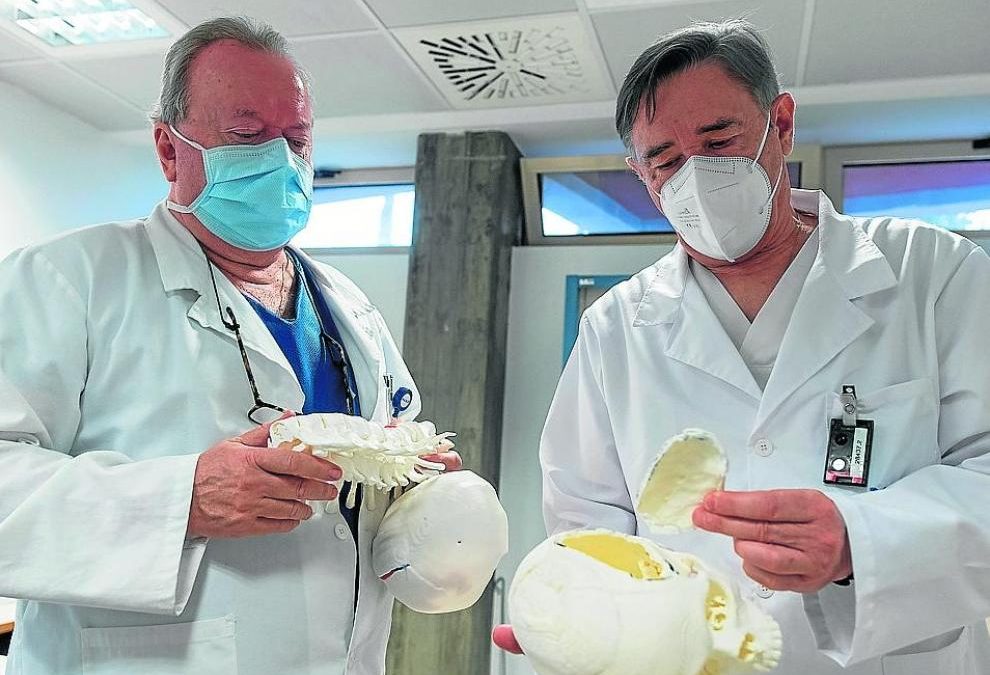
The MAZ Hospital implemented a virtual body donation program two years ago, which allows working on three-dimensional impressions.
New technologies offer multiple possibilities and Medicine is no stranger to them. At the MAZ Hospital Zaragoza decided, two years ago, to implement a virtual body donation program, analyzing its characteristics, medical-legal, clinical, organizational and operational aspects, which is the basis that allowed 3D printing anatomical parts of real patients to practice complex interventions that the Neurosurgery team of this health center faces.
Doctors José Aso Escario and Ricardo Arregui, clinical head and head of the Neurosurgery service at the MAZ, explain that they have donations from about 70 patients. This donation project, they remember, had several objectives: healthcare, teaching and research, with the University of Zaragoza and the Institute of Legal Medicine, and they aspire to achieve "greater transversality." 'Imaging techniques' make it possible to obtain digital files with the patient's virtual body, as expressed in an article published in the Spanish Journal of Legal Medicine, and thanks to them it is possible to "perfectly reconstruct even the physiognomy." This fact, often unknown to the patient, together with the transfer of data contained in the images, makes it necessary to have informed consent in order to later use these models in teaching and research.
These are the bases of the donation program, called 'Dovi-MAZ': "That the patient knows what he is donating and what the objectives of said donation are." «It occurred to us – neurosurgeons remember – that The last phase would be to convert that virtual model into a real one through 3D printing», which is the phase they are now working on.
suitable material
A job that allows them printing on materials that are visible in rays or that have a consistency and hardness “exactly the same as anatomical parts”, the professionals explain. Manuel Gil Begué, responsible for Quality and Innovation at the MAZ, specifies that, to materialize this initiative, he contacted Manuel Bernal, an engineer trained at the University of Zaragoza, to convey to him the needs they had in the project they were carrying out with Neurosurgery: « At that time we couldn't go to the market to look for a 3D printing solution because we didn't know exactly what to order, or what technology, material or printing method to use. That's why I found it interesting to go to the university environment and specifically to the 3D Printing Association».
As a result of this collaboration, and through trial and error, they were able to define how the impressions had to be developed so that they met the requirements of the medical team, in terms of technology and material.
Useful tool in the operating room
At the moment, the service has used these three-dimensional models in about twelve interventions directly, "and in some more indirectly." YesIt is used, in summary, in complex cases that allow the operation to be anticipated. And, in addition, professionals can explain to the patient clearly and precisely the process they are going to follow. In this way, the surgical team can train with the instruments and plan on the model of the real patient, prior to the intervention, how to place the screws, their length, thickness, trajectory...
Dr. Aso Escario explains that this is how surgery can be rehearsed, "which shortens surgical time, provides greater precision and coordination in operations and offers better and more effective treatment in complex cases. It was used, for example, in a patient who had a work accident and suffered a pelvic fracture; or in a severe craniocerebral trauma: «When doing the reconstructions, and thanks to the experience acquired, the difficulty of treating the damage was observed because the superior longitudinal venous sinus was a profusely bleeding structure when repairing the fracture and that if it became obstructed it could cause death or serious injury. The application of these 3D printed models of anatomical parts already extends to other Hospital services, such as Traumatology.





