
Isabel Irigoyen: "We have to talk about suicide, but the key is how to do it"
October 19, 2020
Ramón y Cajal Agüeras: «We try to corner cancer»
October 19, 2020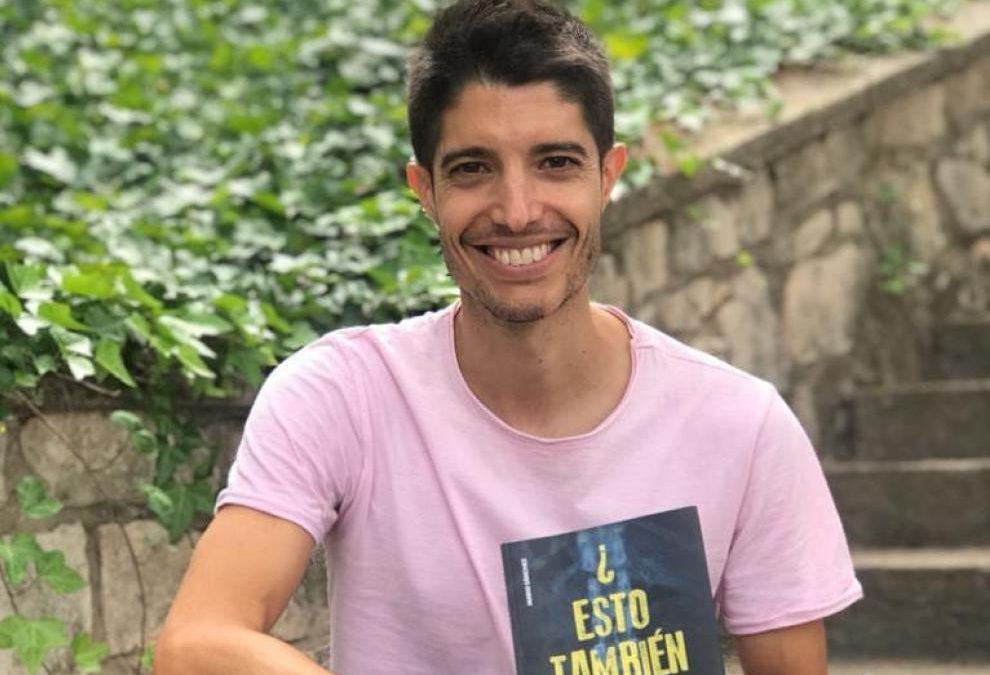
This neighbor Fuentes de Ebro has just published 'Will this too pass?' a fictional book about obsessions, based on his own experience.
Mario Sánchez, an engineer born in Fuentes de Ebro 30 years ago, has just published his first novel: 'Will This Too Happen?'. It is a work of fiction that deals with how obsessions can take over people's lives without us practically realizing it, and it does so based on his own experience.
In this case, Sánchez addresses a topic about which there is great ignorance, such as male eating disorders. In his own words, “some great unknowns” in our days.
“It is very complex to explain. Deep down you feel ashamed because it seems like you are missing something, it is as if you are losing control, but at the same time, you think that it cannot be happening to you,” she reflects. And the problem in most cases is that “you don't want to put a name to what is happening.”
Therefore, for the author, 'This too shall pass?' It is all "an exercise of courage and responsibility that was born with a single objective, to shed some light on this reality to try to help people who go through a situation of these characteristics. The novel tells a fictional story, to which I have added some brushstrokes of personal experiences".
The protagonist suffers from anorexia and narrates in first person the evolution of this mental disorder day by day. “All this arises from my love of reading. While reading I managed to make my thoughts go much slower. Later I was advised to write to reduce the pace at which the mind sometimes works, and it worked,” he adds. The process was so positive that, over time, he saw that it could really help other people.
“When you think about anorexia, the first thing that comes to mind is the image of a 12 or 13-year-old girl; it can be difficult to even associate it with an adult man. I think it has been the hardest part of the entire process,” she admits. In these cases, the disease "sneaks into your life little by little, on tiptoe, practically without warning." That is why he believes it is so necessary to share this story, so that other people can anticipate it, before it is too late.
“It is common to start in a very natural way, for example, trying to take care of yourself. “You take the sport very seriously and you begin to control your diet, something that is socially accepted by everyone,” he says.
"When a habit becomes an obsession it becomes an addiction"
However, Sánchez recognizes that it is easy to start becoming obsessed and that far from what it may seem, it is very common to approach this problem from the point of view of sport, just as happens to the protagonist of the novel. That, added to tight control of food intake, makes you begin to associate the concept of thinness with that of health. “When a habit becomes an obsession, it becomes an addiction, and that is something you cannot stop doing for a single day. That's where the problem begins,” he summarizes.
Patience, effort and support from the environment
“Another of the things that most often marks the process is the feeling of guilt. You feel like it's something you create out of nothing and it's like a kind of self-punishment. We have to discard that idea because it is a disease and as such you cannot control it,” Sánchez points out. A reflection that she, she assures, should extend to the entire society.
Furthermore, with the title of the work between question marks, the writer tries to capture the constant insecurity that anyone who has an eating disorder faces: “I want the message to get across that it is not something strange and that it can happen to you.” To anybody. No matter how bad it may seem that you are going through it and despite the doubts, this too will happen, but without pressure or rush, the important thing is not to stop moving forward, even if it is very little by little.”
And, as Sánchez assures, the battle against this type of disorders is slow and requires large doses of patience and effort, and, above all, the support of the environment. “It is a daily job that is based on winning small battles. It may be months or years, the important thing is to feel good about your body and not worry about going to a scale,” she concludes.





