
«With the pandemic, some obsessive-compulsive disorder that was latent has been accentuated»
8 February, 2021
Facebook and Twitter: another means of contact for Aragonese health centers in the covid era
8 February, 2021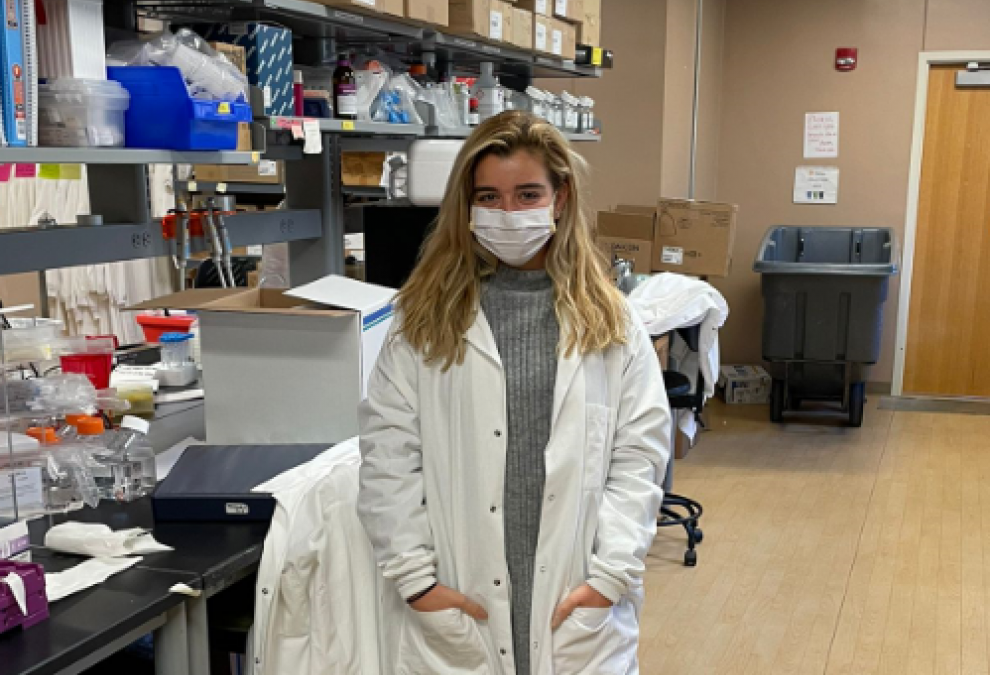
Falceto (Zaragoza, 1997) investigates a cure for brain cancer with immunotherapy and stem cells at the University of Florida (USA).
Only 23 years old and he is already researching a cure for cancer at a University in the United States.
That's how it is. My thesis project is based on studying treatments for brain tumors, in particular glioblastoma, through immunotherapy and stem cells.
How complicated it sounds!
Yes, good. In science we always try to solve difficult problems, but when you find something interesting it is very rewarding. In my case, I am going to use a technique whose inventors won the Nobel Prize in Chemistry in 2020 to genetically modify stem cells. Thus, by combining them with immunotherapy, we hope that the treatment against brain tumors will be more effective.
Where does that passion for science come from?
It's what I've wanted to do since I was little and the truth is that I love it.
Cast?
Several members in my family have died from this disease. Furthermore, it is one of the pathologies that affects the most globally and there are no effective treatments to eradicate it. I have always wanted to research cancer to contribute to society and in Florida they gave me the opportunity.
How long have you lived in the United States?
This is my sixth year. I arrived at Florida Gulf Coast University on an athletic scholarship when I was not even 18 years old. I studied Biotechnology and at the same time I played tennis. When I finished my degree, I did several interviews at different universities to be able to join a project related to cancer.
And, after so much time, don't you miss living in Spain?
On the one hand yes. I miss my family and friends because I only see them once or at most twice a year. However, I know that what I am doing here I couldn't do in my home country. Spain needs to commit to science. In addition, workers' conditions could improve considerably.
That is to say, he does not intend to return.
In other places we are more valued and have more opportunities. To return to Spain, things have to change a lot in my field. Yes, I am considering going to other European countries in a few years to continue researching to be closer to my family.
Getting new findings about cancer is an incredible challenge, but what about researching covid?
When the pandemic began there were many laboratories, including mine, that started with projects on covid. I wanted to start my own study, but I didn't have permission to do experiments. I would have loved to be able to do something to contribute to society.
How is the United States experiencing the pandemic?
It has nothing to do with Spain. There are many infections and deaths daily. The restrictions are minimal. In fact, this week they have made the use of a mask mandatory on public transport. Before not even that. In the rest of the places it still isn't.
Don't citizens wear masks?
There are people who do, but there are many who don't. When I go to the supermarket I get very nervous because families with children come in and no member is wearing it. Is incredible.
Of course, it is one of the countries that is leading the way in the vaccination process.
Compared to how they are handling other things during the pandemic... I think it is one of the aspects that they are doing better than Spain.
Do you know when it's your turn?
I have already taken one of the Pfizer doses. Next week I'll wear the second one. All of us who belong to the College of Physicians of the University have the possibility of wearing it. As soon as I could, I didn't hesitate. It is the beginning of the end.





