

A study shows that red meat damages arteries and increases the risk of heart disease in old age
6 July 2020
Carmen García: «I empathize a lot with the IISA investigations»
6 July 2020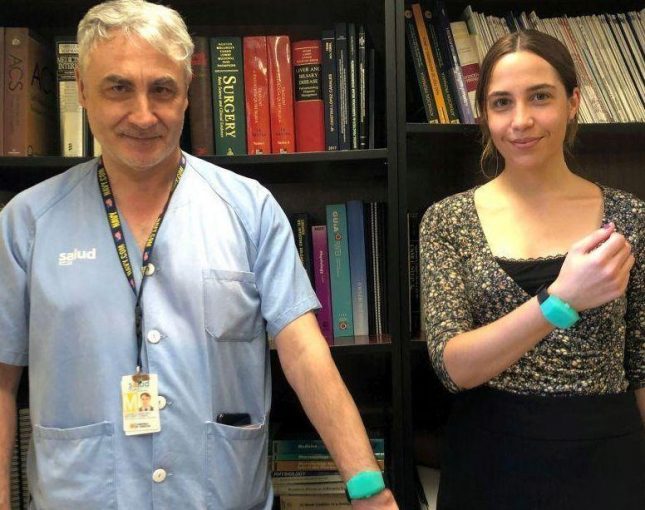
Researchers Antonio Güemes and Marta Baselga have designed a bracelet that, when pressed, dispenses antiseptic to the hand. With capacity for 25 doses, several companies have already been interested
Times of pandemic, health crisis and future uncertainty are also times of research, progress and the search for formulas or resources that help 'fit' an already complicated situation rather than badly. At the Health Research Institute (IIS) of Aragon they have not stopped working on it and their latest creation is a portable bracelet that self-dispenses antiseptic quickly and comfortably in order to facilitate immediate disinfection.
The project, led by Antonio Güemes, head of General Surgery at the Clinical Hospital, and researcher Marta Baselga, aims to contribute to preventing contagion and also stopping its transmission through contact. Several companies have already expressed interest, which means that their arrival on the market is close to becoming a reality.
It is a simple silicone bracelet, for personal use, with a capacity of up to 25 doses of hydroalcoholic solution. Initially it was designed for use by health personnel, but given its function among the population, because it can also encourage the frequency of self-protection, it was decided to create it for the entire public.
To use it you have to put it on your wrist and press lightly so that a dose of hydroalcoholic solution goes directly into your hand. "It can also be used to disinfect small daily contact surfaces, such as a door handle or an elevator button," says Baselga.
This device can be refilled through another hole and by restricting the doses, the environmental impact caused by discarding large quantities of plastic gel bottles with a "insignificant" amount of product is reduced. The self-dispenser is already protected and the goal now is to find companies interested in obtaining a license for its mass production and launch on the market.
For now, the biomedical engineering company Dima, located in Calatayud, has been in charge of producing the first units that have been tested in a pilot project. 25 healthcare workers from the Clinic's Internal Medicine, Digestive, Surgery and Infectious Diseases services participated in the study. After wearing the device for several days, the survey results were very positive. "More than 80% admitted to having asepticized more frequently than usual and considered the device attractive and useful, since each recharge lasts between three and five hours of their work day," explains Baselga.
This initiative has been fully financed by the IIS Aragón within the framework of its own call to support innovative projects that contribute to minimizing the transmission of the coronavirus and facilitating infection control.





