
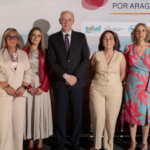
The second Humanize and Care for Aragon Awards recognize eight projects that promote more personalized healthcare.
28 May 2026
TheMoveMen brings cancer back onto the menu and sits it at the bar
1 June, 2026
Research Award in Sector II for a study of Aragonese Research Group in Primary Care from the IIS Aragón on the influence of confinement on the weight and height of children
The runner-up prize was awarded to a study on the use of artificial intelligence in the screening of neurodegenerative diseases using retinal images
The Zaragoza II Health Sector's final residency research award, which includes the Miguel Servet University Hospital as its referral center, has been awarded this year to preventive medicine specialist Alba Gallego, who analyzed the impact of lockdown on childhood obesity. An honorable mention was also given to ophthalmologist Ana Pueyo Bestué for a study on the use of artificial intelligence to improve screening for neurodegenerative diseases using retinal imaging.
Both awards were presented yesterday at the farewell ceremony for residents who have completed their specialized training in the Zaragoza II Health Sector. The celebration took place in the auditorium of the Miguel Servet University Hospital in Zaragoza. Nearly 120 professionals have trained in this health sector in various medical specialties (both primary and hospital care), nursing, and other fields such as pharmacy, clinical psychology, and hospital radiophysics. Those whose training lasts two, three, or four years have now completed their residency. Doctors whose specialties require five years of training will finish in July, at which time another farewell ceremony will be held.
Before and after lockdown
Regarding the award-winning research, its main author, Alba Gallego, a researcher in the Aragonese Research Group in Primary Care The Aragón Health Research Institute (IIS Aragón) explains that the study analyzes how childhood overweight and obesity evolved in Aragón after the COVID-19 lockdown. To do this, they used weight and height data recorded during checkups in the Primary Care Child Health Program for children aged 0 to 14. The years 2018–2019 (the period before the pandemic) were compared with 2021, the period after the lockdown.
The results show a significant increase in childhood obesity:
– Obesity increased from 3,8% in 2019 to 5,5% in 2021.
– Overweight increased from 14,5% to 15,8%.
– The increase was greater in those over 6 years old.
– Boys showed higher figures than girls, although this difference narrowed in 2021.
The territorial analysis reveals that the differences are not solely explained by living in an urban or rural environment. Some intermediate zones and rural areas near urban centers showed higher prevalence rates, confirming that lifestyle and consumption patterns have a greater influence than the administrative classification of the territory.
The study concludes that the pandemic interrupted the downward trend in childhood obesity that Aragon had been experiencing. Furthermore, it identifies the influence of socioeconomic factors—such as income level and family education level—especially in the province of Zaragoza. The authors recommend strengthening surveillance in primary care and designing preventive measures tailored to each region, with particular attention to the most vulnerable areas.
Geography and health
Alba Gallego, also a family physician, emphasizes that the multidisciplinary approach has been crucial to the study's success. "This work has been made possible thanks to the Primary Care Research Group, the Feminization and Ethics of Healthcare Professions Research Group, and the Spatial Planning Studies Group at the University of Zaragoza, among others," she explains. "It has been a real privilege to collaborate with everyone. Although they may seem like very different fields, geography has a great deal to contribute to health analysis," she said.
The doctor also highlights the symbolic value of the recognition for the specialty of Preventive Medicine and Public Health. “It’s a little-known specialty, but research is an essential part of our training. We often work as support technicians, contributing methodology and analysis, and we don’t appear in the headlines that often. But we are that ‘little ant’ that sustains much of the work.”
Artificial intelligence for screening neurodegenerative diseases
On the other hand, the runner-up prize in this annual call for Sector II Research Awards has been awarded to a work published in Artificial Intelligence in Medicine, which proposes a fully automated system based on artificial intelligence to analyze optical coherence tomography (OCT) images of the retina.
Researcher Ana Pueyo Bestué explains that OCT is a rapid, non-invasive test widely used in ophthalmology to obtain high-resolution images of the retinal layers. The innovation of this study lies in the use of an advanced artificial intelligence model specialized in image analysis, capable of improving the accuracy of neurodegenerative disease screening by detecting structural alterations in the retina early.
This approach opens the door to faster, more accurate and accessible diagnostic tools, with the potential to be integrated into routine clinical practice and facilitate the early identification of pathologies such as Alzheimer's or Parkinson's.
For Ana Pueyo, “this runner-up prize represents important support to continue with the research career and consolidate a line of work that unites ophthalmology and artificial intelligence, a field with enormous potential in the coming years.”
The ophthalmologist emphasizes that combining clinical work, specialist training, research, and doctoral thesis work during her residency has been possible thanks to the GIMSO Ophthalmology Research Group at Miguel Servet Hospital, led by the head of the Ophthalmology Department, Luis Pablo. The doctor also expressed her gratitude for the support of Elena García, the principal investigator of the Neuro-ophthalmology group.
These awards highlight the role of residents in generating knowledge and the importance of applied research within the public health system.
Farewell to residents, today also at the Clínico
In addition, today marks the farewell ceremony for the residents who have completed their training in the Zaragoza III Sector, which corresponds to the Lozano Blesa University Clinical Hospital. There, 106 graduates in Medicine, Nursing, Clinical Psychology, Biochemistry, and many other specialties from five teaching units have completed 2, 4, or 5 years of training (depending on the specialty). (This includes the Calatayud Sector and the Nursing and Geriatric Medicine residents who train at the San Juan de Dios Hospital).
In Sector I, which is the one that has as a reference the Royo Villanova and Nuestra Señora de Gracia hospitals, another 32 professionals have been trained, in addition to the 16 who have completed their specialty in the Huesca and Barbastro sectors and the 24 from the Teruel and Alcañiz sectors.
Source: health DepartmentGovernment of Aragon





