
Differences between flu, cold and coronavirus: similar symptoms, but not the same
October 5, 2020
Manuel Valiente: «Short-termism is very dangerous, we will overcome the covid but the cancer will still be there»
October 5, 2020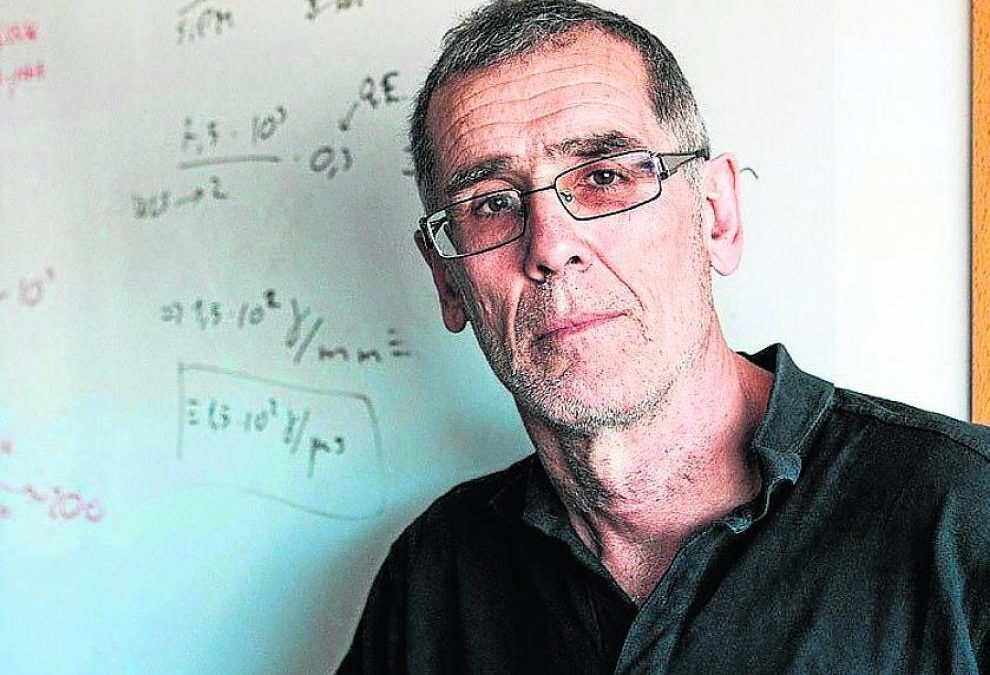
Juan José Gómez Cadenas. Physicist and writer. He directs the NEXT experiment at the Canfranc Underground Laboratory (LSC).
The pandemic is not only the subject of analysis by virologists. The renowned scientist Juan José Gómez Cadenas pursues the coronavirus with the arguments of Physics.
A few years ago I interviewed him at the Delicias Station. You came from Canfranc heading to Madrid. Professor Gómez Cadenas does not stand still. What did he do today before the interview?
Today is an ordinary day. I got up well before dawn. I've had an hour to walk with my wife. Next, at 8.30, I had a conference with Japan. Also, with Carlos Peña Garay, director of the Canfranc Underground Laboratory (LSC). We are preparing a collaboration on Neutrino Physics between Japan and Spain. Before starting this interview (11.00), I have been performing data analysis. This afternoon I have several more meetings. At six in the afternoon (18.00:XNUMX p.m.), a seminar on covid with the virologist Margarita del Val.
He now usually resides in San Sebastián.
I was born in Cartagena. He studied Physical Sciences in Valencia. Then, at CERN (European Council for Nuclear Research) in Geneva. Also, at Stanford University, in California. Then I went to Harvard and Massachusetts. Also, in Madrid, research professor at the Higher Council for Scientific Research (CSIC). Of course, Canfranc. The most recent is San Sebastián, as a professor at Ikerbasque at the Donostia International Physics Center (DIPC), a center of the highest level of Physics. My life takes place between San Sebastián, Canfranc and Valencia.
Fascinating what they are up to in Canfranc.
I am passionate about the NEXT experiment (Neutrino Experiment with a Xenon TPC). There we develop Fundamental Physics, that is, we try to answer big questions that are of no use, except that later they do.
But do they work or not...?
The president of my center, Pedro Echenique, Prince of Asturias Award winner, speaks of the sublime usefulness of useless science. At Canfranc we do a sublime useless science, which is later very useful. Useless science is trying to prove that the neutrino is its own antiparticle. If so, it would explain why in our universe there is only matter and no antimatter. Many people ask me, what is this for?
Professor, what is it for?
Apart from getting to know the universe better, it helps us find some useful applications in medicine: xenon in liquid state to detect tumors in the entire body in a scanner. That is, in a person who suffers from a liver tumor, also know if he or she has a metastasis to the brain, for example.
I think it works...
In San Sebastián we develop detectors to find the coronavirus. There are slow tests, others very expensive, which require specialists. We are looking for a detector similar to the one we use to find neutrinos, which is capable of detecting the presence of these viruses in a sensitive, cheap and online way. We want to electronically detect the coronavirus. It would be very useful. Imagine yourself in an airport, for example. Throughout.
We are facing the Spanish Asimov.
You just named my idol. My father wanted me to be a sailor like him. Until at COU I came across the book 'Introduction to Science' by Asimov, which completely changed my life. Geneva, Stanford, Harvard, the CSIC, Canfranc, now San Sebastián, everything came later.
Furthermore, I am faced with a notable writer... I found 'The Nuclear Ecologist' very interesting.
It opened a debate, in my opinion, that was necessary about nuclear energy. This book spoke with data, as science does, with facts, with numbers, moving away from approaches related to feelings and viscera. Nuclear energy, like any other energy, is not a panacea; but it is necessary.
Now he has just published 'Virus. The Billion Year War', a deep reflection on the pandemic.
I have written it with the biologist Juan Botas. We try to explain the coronavirus, contextualize it. And above all, inform. Because data, real information, are the best formula against fear. Also, against the coronavirus.





