The Ministry of Science, Innovation and Universities grants 625.000 euros to eight projects of the Aragón Health Research Institute
21 June, 2021
The ordeal after a tick bite…
21 June, 2021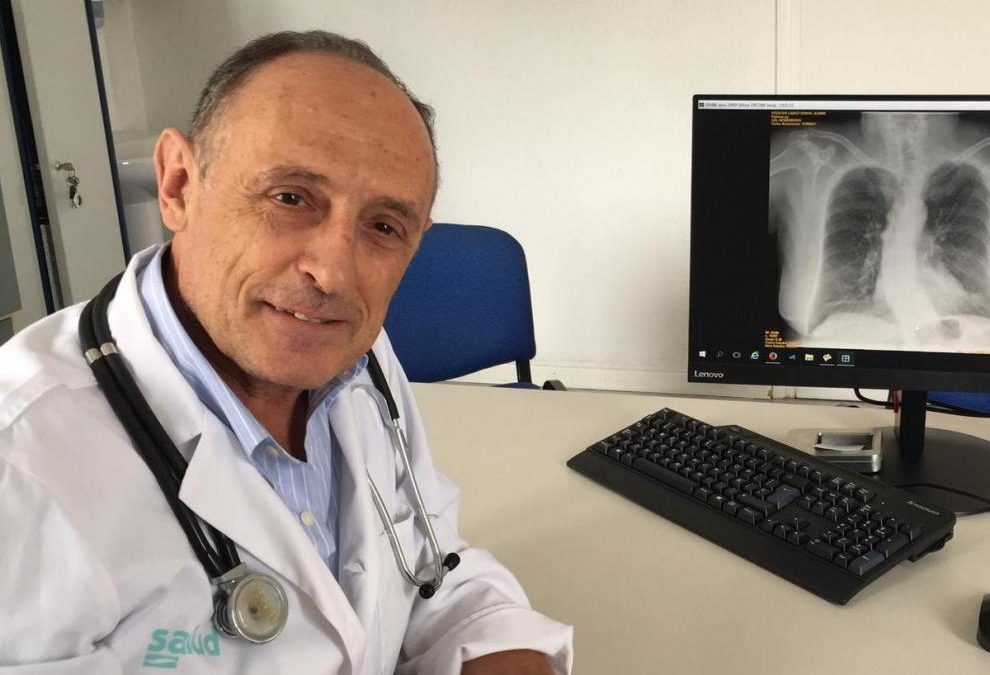
The Servet pulmonologist and professor of medicine at the University of Zaragoza José María Marín is among the most influential medical researchers in the world in the field of obstructive sleep apnea. His research published in 2005 in 'The Lancet' is the most referenced text in the world.
The pulmonologist Miguel Servet Hospital from Zaragoza José María Marín is the most cited specialist in the world in the field of Sleep apnea, where his works and clinical research have been referenced more than 2.700 times.
Patients don't know. Neither I have told them nor anyone has told them, and it is better that they do not know (laughs). The most important thing here is the healthcare work of hospitals like ours. The research part is extra and you do it in addition to assistance. But what is gratifying is that patients know us for the treatment we give them and the quality of care we can offer them. I don't know any clinical researcher who is not a good healthcare physician. What medical research also provides you is a stimulus to maintain a study and update your medical knowledge, which obviously in the end leads to improved management of your patients.
- Spain, although investing half as much as the EU in research, occupies third place in the ranking of the 19 countries of origin of the most cited articles, behind two references such as the United States and to Canada. What reflection does this information deserve for you? Do we know how to do more with less?
You said it yourself... Our healthcare structure is based on the fact that it is a National Health System. The fundamental employer of our doctors is that system, so if you want to do something in clinical research, which is my field, the logical thing is to work in large hospitals of the National Health System (in my case, Servet). Here they pay you for working and the important thing is dedication to care. But once you have covered the obligations that they indicate, The system allows you extra effort and makes it easier for you to carry out clinical research. Let's say there are no big drawbacks if one's initiative is strong enough. Now, there is no release of time to do clinical research. In the end It is something completely vocational. If you don't like it, it's better that you don't do it because it's going to be torment. You have to take a lot of time away from your family, put in a lot of extra hours... it has to compensate you in vocational terms.
- When did you get the 'bug' to dedicate yourself to research?
In the year 82, when I started my Pulmonology residency at the Royo Villanova Hospital, I was lucky enough to meet tutors who at that time They stimulated me for biomedical research. They gave me poison, and I have never left it. I was also lucky enough when I finished my residency to spend a long time in to Canada, and that was my takeoff as a medical researcher. When I returned to Zaragoza I came already loaded with that attitude towards medicine in general.
- Is good science done in Aragon?
There is great variability. There are leading groups, which have an international level, and I believe that We are at the average level of the country taking into account the resources that our region has. If I look back, there are two elements that are promoting biomedical research in recent years: the increasingly growing importance of Aragon Health Research Institute, which is increasingly stronger, and own University of Zaragoza, which really It is promoting biomedical research in Aragon a lot. The initiative of the two large hospitals in the region is variable, but is increasingly supported by the Health Research Institute of Aragon and by the University itself.
- Is there more and more interest in dedicating yourself to research?
This is especially so in the case of biomedical doctors and biologists. In the case of doctors, The percentage of our young people who get involved in research is not very high and since the professional opportunities are not bad at all, we don't even manage to incorporate them into the groups we already have in the hospitals. It's the drama we have, that we look back and I am not sure that enough people follow us with concern... Research requires putting in many hours in the afternoon, taking a lot of time away from the family... We have done that, and it is about making it easier for the new generations, that they do not repeat the effort we have made.
- What has to change for this change to occur?
The future is bright if the benefits that research gives to young people mean progress in their healthcare careers. The big problem that has existed and exists at this moment is that It is difficult to attract young specialist doctors to biomedical research because it is really very expensive in personal terms. For example, a doctoral thesis, which is the summary of a research project in relative terms, is worth less than working four or five months as an interim. Unless the merits are resized, I see it as difficult for young people to join research groups. In the end, if your effort is rewarded by tangible merits, people will obviously get involved. But if you are going to make an effort and that effort is not going to have a reward, it is more difficult, so currently it is difficult to involve young doctors in biomedical research in general.
- Does the same happen in other countries?
Not exactly, because in North America if someone wants to have a university degree there are very clear guidelines: you have to get involved in research groups and from publications you acquire a career and a research curriculum that helps you achieve goals at an academic level. This is inherent to assistance. What large academic institutions want is for their qualified staff to have this double line of academic and healthcare excellence. In our country, the National Health System what values you is your healthcare capacity. It is true that at the university you have to demonstrate a series of merits, and there are national agencies such as the famous Aneca that qualifies your merits for it. But in principle, In the National Health System, the research part is not the most relevant for your career.
- How a Servetus investigation becomes the most referenced work in the world.
The apnea study cited We published it in 2005 in 'The Lancet' and it referred to extensive research that we began in the 90s, when the Sleep Unit was created. The merit of this study was to collect the clinical follow-up of the patients after ten years, and realize that patients with severe apnea who were not being treated They had a higher risk of mortality and cardiovascular disease. Since we were the first to publish that, today we are the most referenced, since the one who publishes first is the one who really takes the credit.
A reference unit in Aragon
"The first ten or 15 years they even sent us patients from outside the region, because at the beginning in Spain there were no respiratory sleep disorder units"
- How many patients have passed through the Unit since then?
- In this year of Covid, have your patients had to take special care?
Not especially. We are already taking stock of this and could conclude two things: that They have not been at greater risk of suffering from the coronavirus than if they hadn't had sleep apnea; and that when they got sick from covid it seems that The devices they wore have helped reduce morbidity damage related to him coronavirus.
- Do you want to return to in-person attendance?
I burn with desire for him to return. I don't understand my work on the phone. Our patients want to see us and we want to see our patients. It is also true that, as has happened in other areas, The follow-up of ours was mortgaged by the semi-principled, which we had to make up for with phone calls and other alternatives. Now we are functioning at 50%, but we are eager for all this to end so we can return to 100%.
- Is there an end to this pandemic in sight?
There is control, but science in general thinks that we are going to go from pandemic to pandemic. There is enough data that indicates that there will be a periodicity of pandemics. It is not known if every 3 or 5 years... But of course pandemics are here to stay. The other thing we see is that We may have to get booster shots every year until the virus is gone.
- Do you think it is too soon to relax the use of masks?
Masks have had a parallel advantage which is the drastic reduction of other respiratory infections: there has hardly been any flu this winter. Cases of bronchitis They have been substantially reduced, and all this has been due to the mask, because our patients were protected with it and they were in turn protected by other people who could be infected by non-covid viruses. It has been a measure that, in addition to reducing the transmission of the virus, has reduced other diseases, and I believe that its use in public places should not be reduced yet. Obviously, if you're alone, you can do whatever you want. But in any public place where you live with more people The logical thing would be to maintain it until the pandemic is well controlled, and I would not set a date to withdraw it in the near future. There are many countries where you travel there and for many years you find that customs officers take it. This is typical of Japan or China. The mask is really an excellent instrument to avoid transmissions. Many of us who are in direct contact with patients believe that in the future we will receive them with a mask, regardless of whether we are in a pandemic or not.