
Keys to coping with confinement
11 January 2022
The long-term benefits of olive oil, supported by research
11 January 2022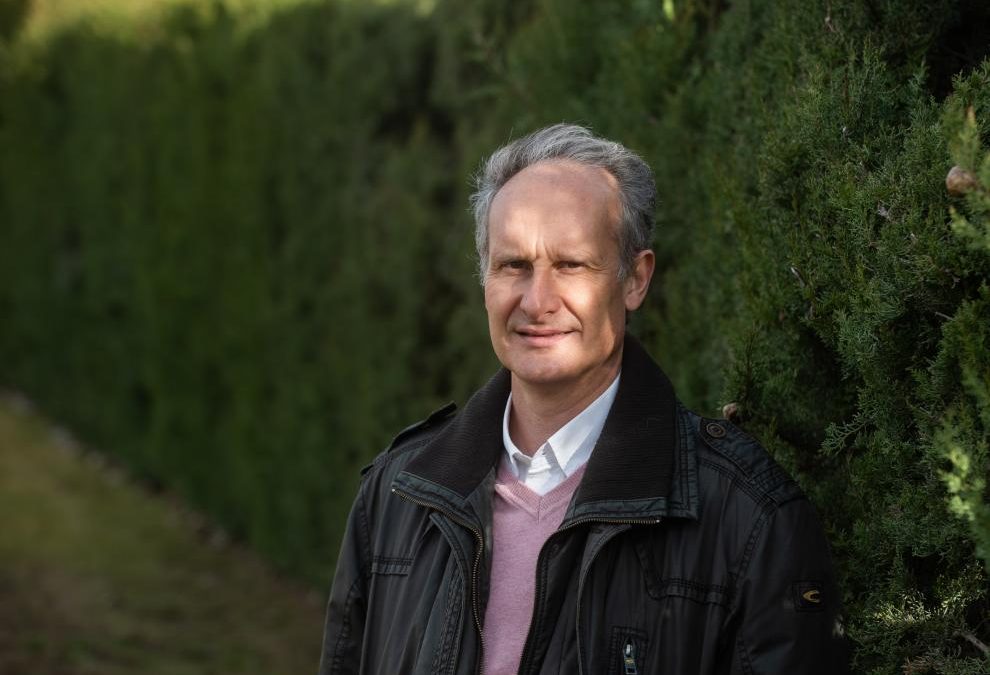
The researcher at the Institute of Nanoscience and Materials of Aragon publishes '2037. Neuronal Paradise', a novel that explores the ethics of neuroscience
Stockholm, December 1906. JJ Thomson and Santiago Ramón y Cajal meet in the Swedish city to collect their Nobel Prizes in Physics and Medicine, and talk about their respective fields of work. Perhaps there began the development of neuroscience, a discipline that today is on everyone's lips. That historic meeting was the first flash of the novel '2037. Neural Paradise' (Mira Editores), which has just been published by José María de Teresa, professor of Nanotechnology at the University of Zaragoza and the CSIC. The work partly follows the lead of George Orwell's '1984', in the sense that it imagines a near future, 2037, in which neurotechnology has developed far ahead of the law and raises profound moral and ethical debates. It is a novel, but in part it tells us that the future is here, around the corner.
It is not very common for a Nanotechnology professor to write a work of fiction.
In my case, no. I have always liked letters. In fact, I wanted to study Philosophy, although in the end I decided on something more practical, Physics. I did my doctoral thesis in Zaragoza, I did my post-doctorate in Paris and there they gave me two historical novels written by an astrophysicist and which were very good. That made me see that you can write novels perfectly from science.
His novel, unlike Orwell's, which considered the future almost 40 years in the future, focuses on the short term. And he proposes changes that are difficult to accept, such as there being human beings with implanted microchips.
What does short term mean? If we think about five or six years, yes it is, but most scientists believe that this possibility, that of having microchips implanted in the head, may be a reality within 10 or 20 years. Sensors are being perfected to study how the brain works. At the moment it is done through external devices, helmets, headbands... But in the future you could have it implanted and under your control. When that moment arrives it will be a real revolution: it will change human nature. You will be able to connect wirelessly to the Internet and immediately access all of Humanity's knowledge. Those who access this technology will be 'augmented beings', they will exponentially multiply their brain activity. Today we are already seeing big differences between those who access the internet and those who do not, such as some older people. But the difference between 'augmented beings' and the rest, in the future, will be abysmal.
His novel breaks a taboo that Orwell did not dare to do, that of absolute cerebral control.
To write it, obviously, I reread '1984', and I did it with a new perspective. And it surprised me. The leader, Big Brother, could see everything and controlled everything except one thing: he could not access the inside of people's brains. In that world, one could say one thing and think another, one could pretend. The technologies that arrive in the field of neuroscience will allow us to 'enter' the brain. With artificial intelligence, not only will it be possible to access it, but it will also be possible to have more information about a person than themselves. Therefore, with the novel I wanted to make a wake-up call. Now we are at the moment of legally regulating all this. If we do it before the technology is developed, no one will go beyond the predetermined ethical limits. If you let technology develop freely, it will be much more difficult later.
To think that one can have a brain implant to improve their life or their learning capacity, and that this can be used by someone without ethical limits to somehow access your brain is very science fiction, almost conspiratorial. But before I talked about helmets and headbands, and they already exist. Here in Aragón we have the example of Bitbrain, a company that studies brain functioning using headbands with sensors.
Bitbrain does this for medical purposes, to design exercises that improve the person's brain condition. But there is a lot of research underway. Google and Facebook are already developing their own helmets and headbands so that there is interaction with the mobile phone. They are developing them with great confidentiality. And then there are implanted electrodes, which are also now a reality. Last year, the magazine 'Nature' published a study carried out with quadriplegics, who were able to decode the electrical signals in their brain while they thought they were writing. They were asked to imagine a letter and it was detected that for each of them there was a different electrical brain signal. Thus, they managed to write at a speed of even 100 characters per minute.
This technology will be developed.
It seems inevitable. Headbands, or helmets, will end up being marketed, which will improve our daily lives. Imagine being able to access all languages and have an immediate translation of something they are telling us in a language we have no idea about. These helmets or headbands, to give an example, will begin selling perhaps at 500 euros per unit and as they become popular they will end up selling at 20. But I do not see an ethical problem in them, and I do see in what will be the second phase of this technology. .
The implanted microchips.
We don't know much about what is being done because it is carried out with complete confidentiality. But Neuralink, Elon Musk's company, has already reported that it has implanted microchips in pigs and that they read information in some areas of their brain. At the moment, in very basic things, like if the animal sniffs out food it likes. But it has invested 150 million euros to build the robot that performs these implants and has already announced that in 2022, this year, it will begin research with human beings. I don't know if it's true or not, but the ad is there. And all this happens when in a microchip we are already able to fit 100 million transistors in a square millimeter.
But a human brain does not work like a computer.
He does it differently, yes. It has memory and data processing integrated, it is a different architecture. But computers are evolving in several ways. On the one hand, because of quantum computing, which does not store information in a binary way, which will give them much more capacity. Also through artificial intelligence algorithms. In the mid-90s the world was surprised when the Deep Blue computer beat the best human chess player. Now there are machines that are not even programmed. They are told to 'start playing' and as they go they learn the rules of the game and are able to beat the best of humans. Another way in which computers are evolving is neuromorphic computing, through computers that have the same structure as our brain.
Before I spoke about the urgent need to set limits, to legislate. What rights are in danger?
First of all, privacy. Neurotechnology will allow our thoughts to be read. We must also preserve free will regarding those devices that will arrive and with which we will interact. Today we are seeing it: Google, when you start typing a word, already offers you how to finish it. These devices are going to propose things to us and we must be absolutely free to choose between the options. Identity problems also arise. There are implants in people who have a medical problem, such as epileptic patients, in which an alarm goes off when certain signals are detected in their brains. Some of them claim that they have different reactions than they would have if they were not implanted, that they are not sure of being themselves. Equal access to these technologies should also be regulated so that two societies are not created at different speeds, as happens in '1984', where there are those who follow the leader and have certain benefits, and those who remain on the sidelines. And, finally, access to the information generated by these new devices would have to be regulated in very detail. Today we already know that even algorithms have a bias.
Technology is not always beneficial.
I don't know what future awaits my children and grandchildren, although I would like to be here to see it. Adapting to changes as profound as those that are coming is scary, although digital natives may see it differently. Technology is used to help people, but if it is very powerful and misused, it can cause a lot of harm. I already notice a lot of difference between how things were in my youth and now. Before, to give an example, you made a mistake and you had the right to a second chance. Now, with the internet and social networks, everything is different. People are more careful every day with what they say, what they write, even with what they think; cares about respecting general lines of thought. And I don't like this very much, in a certain sense it seems to me that we are evolving towards what Orwell predicted, a society in which everything is very controlled. Nowadays everything is digitalized and we put all our data in files over which we may not have as much control as we would like. "Technology makes us better as a species, but it does not make us freer."





