
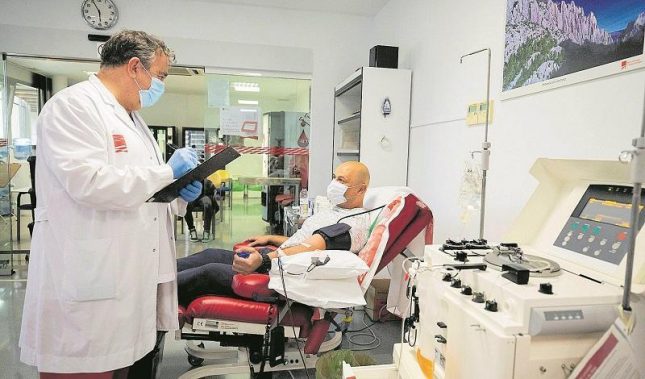
Aragón reaches 300 plasma transfusions to coronavirus patients
October 19, 2020
Mario Sánchez: “Male eating disorders are largely unknown”
October 19, 2020
Irigoyen is a psychiatrist and coordinator of the Strategy against Suicide in Aragon
Dr. Isabel Irigoyen has been a psychiatrist at the Zaragoza Clinical Hospital for 17 years and has been appointed by the Government of Aragon to coordinate the first Suicide Prevention Strategy in the community. She takes it on as a “challenge” and with the optimism that “things are moving” on a hitherto taboo topic.
Is the strategy against suicide in Aragon late?
I think it comes late in relation to the fact that it is a problem that has always existed. The administrations have tried to be very cautious, because it is an issue that worries but in which there is a lot of fear about how to address it. There has always been a balance between risk and benefit and there it was always thought that there was more risk. Now, at least, there is a proactive attitude to intervene and in the case of Aragon it is a very ambitious strategy, with many groups involved, and that is the great value of this project.
An average of 113 suicides a year in Aragon is a lot of deaths. Is society aware of this reality?
No. The numbers are very cold, but if you say one suicide every three days in Aragon and ten a day in Spain, it tells you something else. If you put it in relation to other deaths, which involve family tragedies such as traffic accidents, it is placed much better. People there are surprised because there is no awareness that it is such a serious public health problem. Now we are immersed in the covid pandemic, where a brutal investment is being made from all sectors and where there will end up being 50 vaccines, while suicide will continue.
Does the call effect exist?
It exists and we professionals see it very clearly. Death in a close environment, or in influential people and even well-known and famous people, can facilitate another suicide in people already at certain risk. That effect is like this. We have to talk about things, but the question is how and not so much what. For years there has been a veto on this issue, especially in the media, because they did not know what to do. The ban is beginning to open in Spain, so to speak, as a result of the evictions. That was the turning point. The problem is that suicide was instrumentalized in some cases and the news was misused because the event was described, with unnecessary details, and information was not given, which is what should be done.
«We psychiatrists also go through an adaptation. "It's hard when a patient dies."
Why is it important to talk about it and verbalize it?
Because verbalizing it is a way of giving information to the population. This can happen to anyone even though we always think that it can't happen to us because we are fine. However, if we place ourselves in a context of loneliness, without hope or with a lot of discomfort, in these circumstances the idea of death as a way out of suffering may arise.
The truth is that it has always been a taboo subject.
The topic of death is very difficult for us in Mediterranean and Christian society to talk about. We have not been taught and it is also difficult for doctors. When someone in the environment says something related to this, we quickly cut it off with phrases like "don't talk nonsense." We do not give the option to speak, which is precisely what is needed at that moment.
Is medication necessary or can other routes be chosen?
Suicide is not a pathology, it is a complex situation that can occur within or outside of an illness. 10% of suicides occur in people who are mentally healthy, but the remaining 90% are people with some type of mental disorder that must be addressed. The shape can be varied. In some situations, psychotherapy is sufficient and, in others, where there is severe distress, medication is necessary. A suit must always be made to measure for each patient.
You deal with these people face to face. What do you feel?
A great responsibility is felt because we are the ones who apply a measure that is going to have more or less impact. We are already taught for that and before obtaining the specialty there are years of training and we go through some situation like this. It is also true that we support each other a lot in the work teams.
Do you disconnect or somehow take the cases home?
Obviously it does not go unnoticed when there is a patient at risk, because in some way you take it with you when you leave the hospital, and if it ends with a completed suicide, that is present there. We also have to do our adaptation process. As psychiatrists, patients die when they commit suicide; Other specialists suffer from it in a different way. In medicine we always live with death.
Is there a clear profile?
The profile is very varied and suicides occur at all ages. The only group with hardly any incidence is that of the first decade of life, up to 10 years of age. In practically all countries, for every three men, one woman dies and they are people from all social groups, religious beliefs or professional profiles, whether successful or not. No one is exempt from this risk. They are people who at a given moment see everything black, they do not feel an alternative to anything, they have a really bad time. If we empathize with them, there is an option to save them. That is why universal prevention must be done.
The hospitals in Aragon deal with between seven and eight attempts every day. Do patients show regret?
For each suicide there are 20 attempts, some of which are very minor and others are serious, which we know as highly fatal. In these, death is sought, but there is a repentance that is more frequent than is believed. Fortunately, there are people who normalize their lives and do not try again, but all of them must criticize the attempt, where they are aware that they should not have done it or that they should have asked for help.
Young people are a risk group. Should prevention start in educational centers?
Yes, we have already started to have contact with the institutes because the entire adolescent population is there and also with the minors' service. It is one of the lines of action of the strategy.
Does Aragón have enough resources in Psychiatry?
There is a shortage of resources and the department knows it. They are aware that the network is limited and must continue to grow, but it is necessary to launch specific programs within the specialty itself. We are on the way. Medicine is a challenge in general, but psychiatry is more so and I see that things are moving. I am optimistic and I see good predisposition.





