
Patricia Sancho, the Aragonese researcher who has achieved a milestone in pancreatic cancer: "It's a source of pride to be all women."
22 July 2025
76% of gastric cancer cases could be prevented
23 July 2025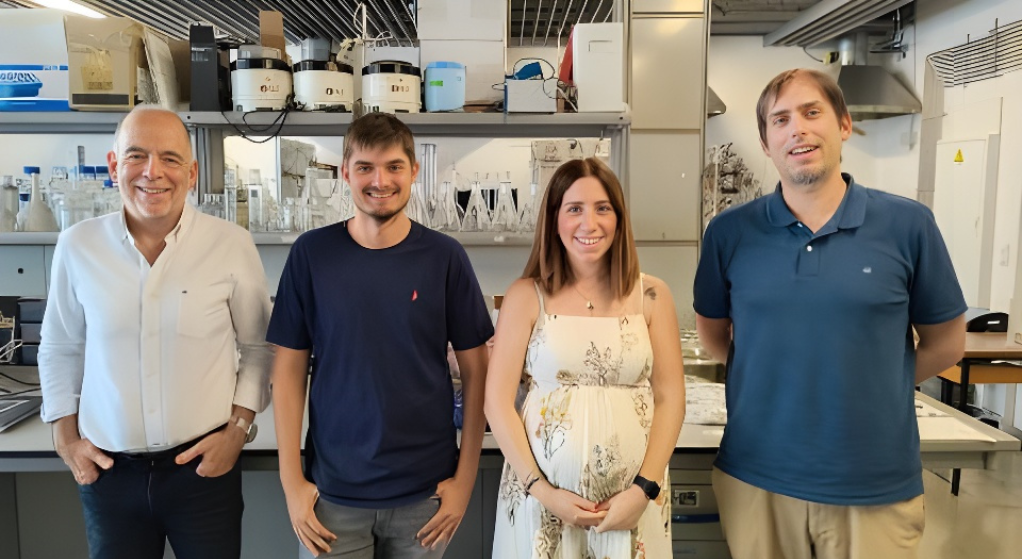
Experiments carried out with cellular and animal models corroborate the efficacy of this combined chemodynamic and photothermal therapy.
The journal "Advanced Functional Materials"«; publishes the results of the work carried out by researchers from the University of Zaragoza affiliated with the INMA (CSIC-Unizar), IIS Aragón, and CIBER-BBN
A group of Aragonese researchers has just published un important conceptual advance in the fight against cancer by designing nanoparticles that evolve in the tumor environment, generating two different therapies in succession. Although these results are in the proof-of-concept phase, experiments with cellular and animal models have corroborated the efficacy of this combined therapy.
The prestigious magazine Advanced Functional Materials (https://doi.org/10.1002/adfm.202502999) has just published the work «Evolving Platinum-Copper Nanostructures for Enhanced Photothermal Therapy and Controlled Copper Release in Cancer Therapy", in which they have participated José Ignacio García-Peiro, Maria Sancho Albero, Andrea Mosseri, Jose Luis Hueso and Jesus Santamaria, researchers of the University of Zaragoza at the Institute of Nanoscience and Materials of Aragon (INMA, a joint center of the Spanish National Research Council, CSIC-Unizar), the Aragon Health Research Institute (IIS Aragon), and the Biomedical Research Network Center for Bioengineering, Biomaterials, and Nanomedicine (CIBER-BBN). The researchers also collaborated on the work. Rafael Contreras, from the University of Granada, and Felipe Hornos, from the Institute for Research, Development and Innovation in Health Biotechnology in Elche.
Specifically, the developed nanostructure is capable of evolving in the tumor microenvironment to develop two therapies that cooperate in the death of cancer cellsInitially, the nanoparticle releases copper, a metal that, as previous work by the same group has shown, is capable of activating chemotherapeutic pathways within the tumor itself, triggering reactions that generate highly toxic reactive oxygen species. Copper release is selective because it accelerates under conditions typical of the tumor microenvironment: moderately acidic pH or relatively high glutathione concentrations.
However The most distinctive aspect of this work lies in the evolution of the bimetallic nanoparticleThe release of copper transforms its texture, converting it into a platinum-rich, partially hollow structure that responds highly effectively to infrared light irradiation. This allows for a second stage of photothermal therapy, generating a local temperature increase that multiplies tumor cell death. "This in situ transformation of the nanoparticles allows for synergistic targeting of tumor cells, using two different therapies in succession," the authors emphasize.
The work is part of the recently completed CADENCE project from the European Research Council, and has also received funding from the Spanish Association Against Cancer for one of the researchers.
Bibliographic reference:
JI Garcia-Peiro, M. Sancho-Albero, S. Miguel, A. Mosseri, F. Hornos, R. Contreras-Montoya, JL Hueso, J. Santamaria, Evolving Platinum-Copper Nanostructures for Enhanced Photothermal Therapy and Controlled Copper Release in Cancer Therapy. Adv. Funct. Mater. 2025, e02999. https://doi.org/10.1002/adfm.202502999
In the photo, part of the research team that carried out the work, from left to right: Jesús Santamaría, Ignacio García-Peiró, María Sancho-Albero, and José Luis Hueso.
Source: University of Zaragoza





