

Those affected by Angelman syndrome: "Research is the great hope of all families"
23 February, 2021
Substances present in lipsticks, dyes or creams can increase the risk of endometriosis
24 February, 2021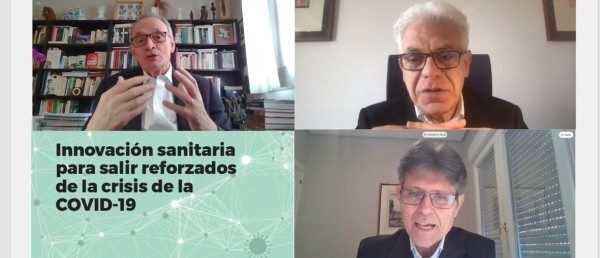
Hiris and Farmaindustria present the book 'Health innovation to emerge stronger from the Covid-19 crisis', in which experts in economics, health management, medicine and research participate
“Each euro invested in health and innovation has a multiplier in terms of economic growth and employment that is much higher than that of investment in any other economic activity,” says economist Antón Costas.
How to get out of the crisis and to what extent health and science can contribute to it. These are the main questions that the book Health innovation to emerge stronger from the Covid-19 crisis tries to answer, published by the strategic consulting firm Hiris with the support of Farmaindustria. “The work, made up of twelve chapters written by some of the best Spanish experts in economics, health policy, management, medicine and research, offers the keys to reversing the current crisis situation and for health and science to become the vectors of change that Spain needs together with its European partners,” indicated Jesús María Fernández, founder and general director of Hiris, at the book presentation that took place this Thursday in a telematic meeting.
One of the conclusions that are repeated throughout the book is the importance of investing more in our health system and also in our research system, Fernández recalled, but also the evidence of the strong association between growth, development and health.
“Covid has been like an epiphany that has made us more aware of the strong links between public health, society and the economy. It has revealed to us that the cost of poor health is unaffordable for a modern society,” stated Antón Costas, one of the authors of the work and professor of Economics at the University of Barcelona, who participated in the presentation of the book.
“The pandemic has made us see that we had the wrong priorities; that investing in public health and health innovation improves, on the one hand, the equity of a country and, on the other, increases the economic efficiency of that country. One euro invested in health has a multiplier in terms of economic growth and employment that is much higher than the investment of that same euro in any other economic activity,” Costas added.
In his opinion, the current crisis has also “made us see that the health industry is going to be, and already is, a driver of economic growth, of the modernization of the economy and of resilience, of the resistance capacity of an economy in the face of new pandemics.”
In this sense, the general director of Farmaindustria, Humberto Arnés, has pointed out that “having a solid pharmaceutical industry is of vital importance for a modern country. It is because of its leadership in drug research. As we are seeing, it is the pharmaceutical industry that leads the R&D of medicines in the world, within a framework of close cooperation with governments and public research institutions. And it is also because it guarantees supply through strong productive networks.”
Arnés also recalled that biomedical research is essential for the quality of healthcare provision. “Today it is not possible to talk about a modern health system of true quality without enormous research activity. Medicine R&D is becoming more open, collaborative and international every day. The unprecedented race to achieve vaccines against Covid-19 has been the best example,” he stated.





