

“Many older people are spending these months at home with serious symptoms of mental illness.”
October 19, 2020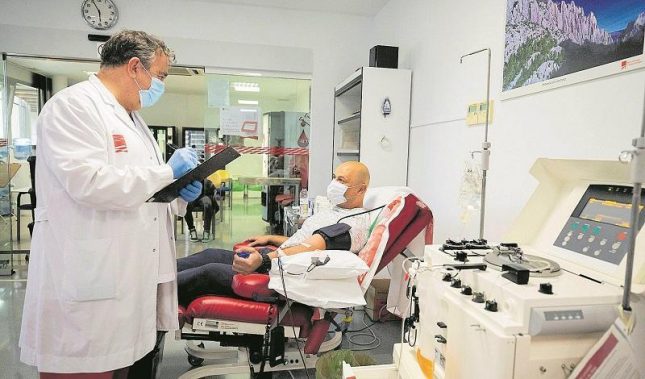
Aragón reaches 300 plasma transfusions to coronavirus patients
October 19, 2020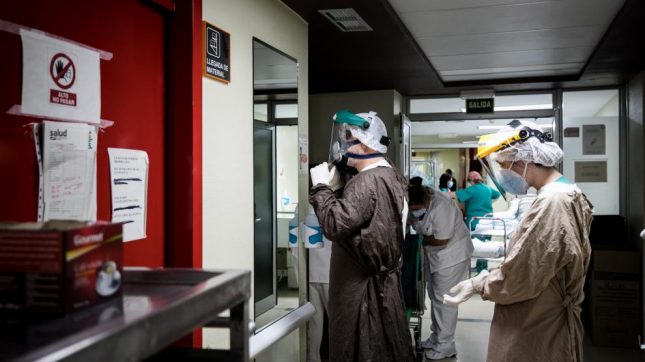
Intensivists warn that the system is becoming so stressed that it will be difficult to hold on. The Clinical Hospital of Zaragoza is already at the occupancy limit in the ICUs and has prepared another unit in case the epidemiological evolution worsens.
Hospital intensive care unit staff are used to working under strong pressure and great responsibility but, since the coronavirus pandemic began, they have had to redouble their efforts to respond to the growing demand for care. In Aragon, the health crisis only gave a slight respite in the first half of July and, since then, the occupancy of covid patients has remained so high that it is pushing the capacity of the ICUs... and the staff to the limit.
A situation that greatly worries health professionals, who recognize that they are "exhausted" after eight "very hard" months of fighting the virus, "disillusioned" by irresponsible attitudes that do not contribute to stopping infections and "resigned" because, as they agree, "there is no end in sight" to this situation. Far from reducing infections, they observe with concern how more and more sick people arrive every day. A morning at the Lozano Blesa University Clinical Hospital in Zaragoza allows us to see the frenetic pace of work of a team made up of almost 200 professionals – including doctors, nurses, auxiliary nursing care technicians, orderlies and cleaners – who allow this complex mechanism to work. every day.
At 8.00:2.812 the morning shift begins in the ICU of the Clínico, the hospital that has treated the most coronavirus patients in Aragon, 183, of which 34 have required intensive care. The unit has 19 beds, is located on the first floor and has reorganized its spaces to create covid and non-covid zones in the medical and surgical areas. Dr. Juan José Araiz, acting head of the ICU service, explains that last Friday, when he went off duty, they had 22 covid patients and the day before, 2. Three of them were in the multipurpose room, which was the coronary unit, which has seven boxes, all with individual bathrooms, now transformed into an airlock to allow staff to put on and take off their protective suits there: "We are at the limit. There are only two free beds, one for covid." In addition to the multipurpose one, which welcomes both patients with SARS-CoV-XNUMX infection and other pathologies, there are two exclusive areas for coronaviruses. In this space, professionals must previously equip themselves with all the protective equipment, with the overload and difficulty that it means for them to remain like this for hours, sometimes up to the entire shift.
Before March everything was for critics of pathologies other than coronavirus. Now, less than half is reserved for them. During the first wave, he says, "it was a very large outbreak in a relatively short period of time." This forced us to open ICUs in other spaces of the hospital, something that at this time has not yet been necessary: "We were confined and traffic and work accidents, scheduled surgery and the rest of the pathologies disappeared. We had all the beds for covid "Now, people continue traveling, working, they have lost their fear of coming to hospitals. We don't have as much coronavirus as in March, but we are almost worse than before." In fact, they work with an occupancy of 99 or even 100%. "That's why when I hear that the rate of available beds in Aragon is 30%, I can't believe it," he says. A healthcare situation that forces them to remove a patient who is "acceptably well" to bring in another who is "dying." On July 16, the first patient of the second wave was admitted and, two weeks later, they began to have average occupancy rates of 95% in the ICU on a continuous basis. "The health system is being so stressed - he adds - that we will not be able to withstand this any longer."
Dr. Joaquín Costán, medical director of the Clinic, shares this vision: "In this phase we are receiving what was usually treated, plus the covid. That means about 100 extra beds in the hospital. More advanced tumors are being seen that are not salvageable at the level of surgery or diabetic decompensations". In this sense, he added: "We live in a stable situation of great tension. We have had more than 100 hospitalized for covid for two months and there is no way for the number to go down, and when you think it is going to go down we see the positivity rates in the population and we know that within a week we will have a percentage of those admitted to the ICU and the ward. It is as if you do not see the end. "The health system is getting tired - he assures -. In the first wave we saw a push from everyone, we were all united to move this forward, but now it is stagnant. That illusion has disappeared and there is exhaustion, disillusionment... applause on the balconies has now become an anecdote."
"It's like two trains collide every day."
Dr. Pilar Luque, section head of the Clinic's ICUs, graphically summarizes the general feeling of the staff: "We have realized that the new normal is this, always having many patients admitted. And it is going to increase. No longer I know if we are tired, dedicated or resigned, that is what we have had. If you look at the number of deaths (at the national level), it would be the equivalent of two trains colliding every day" and causing dozens of deaths. "Every day," he says, "involves three times more work than before and, above all, the problem of not having beds. The first thing we do when we arrive is to see if there are any free, and the second, if there is someone to take. "Departures are brought forward due to lack of space."





