
Silent hypoxia, the 'sneaky' symptom associated with the new coronavirus
4 June, 2020
«Fighting for life is an exciting vocation»
8 June, 2020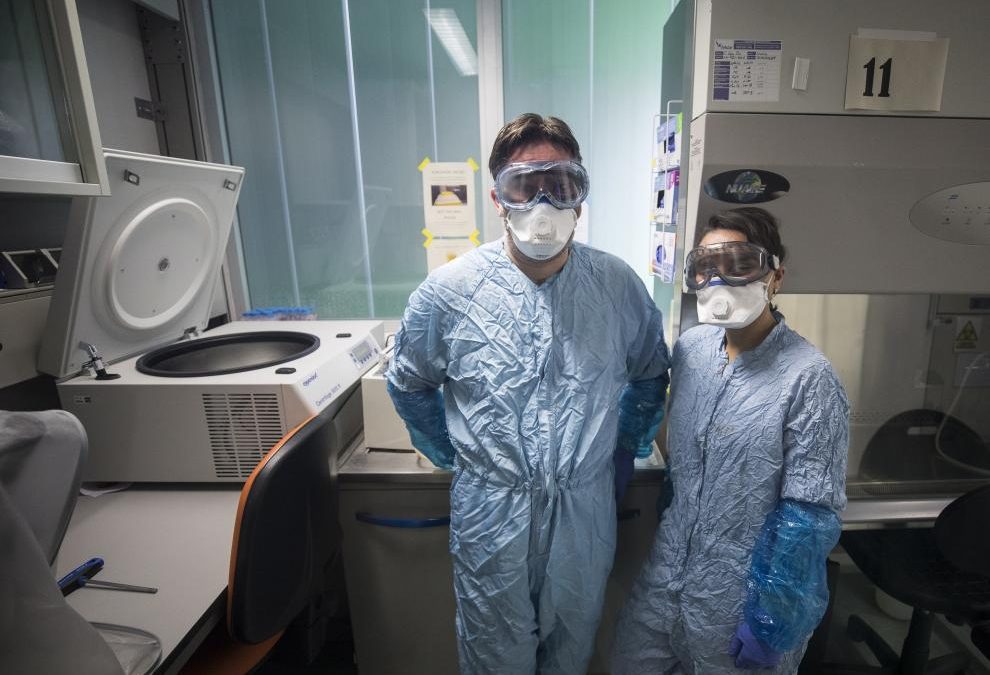
Anti-aerosol devices, anti-break containers, waterproof overalls... Under strict – reinforced – level 2 biosafety measures, Mark Strunk and Ana Medel work with non-inactivated samples from patients positive for SARS-CoV-2. Their work in the CIBA covid room, within the framework of a project to develop a new early detection test, does not convey any sense of risk: "It is almost safer than going on the street," says Strunk, "because we control every step". Medel adds that "helping in this pandemic is a professional and also a moral opportunity"
Never, with any other project – "and look, I work in cancer" – had I felt so much social pressure. Pilar Martín Duque can express it in English: 'overwhelming' (an overwhelming experience). Scientists who research covid-19 "generate high expectations, and we feel pressured not to disappoint: with calls, on social networks, even acquaintances on the street – some believe that you are the new Dr. Simón and that you know everything." the statistics–. The reality is that none of us know everything about this virus and we learn day by day, trying to contribute our part with what we know how to do," acknowledges this Araid researcher at the Aragonese Institute of Health Sciences (IACS) and part of the NFP group of the Aragon Nanoscience Institute.
From a distance, like so many workers in the state of alarm, he remotely directs a project that, with a new strategy, seeks to develop a rapid and early diagnosis test for the virus. A more sensitive test than the current ones and that does not miss those false negatives that, without knowing that they are carriers, spread the infection. It was one of those included in the first rounds of financing – in this case with 71.500 euros for six months – through the Covid-19 Fund managed by the Carlos III Health Institute and "if this goes well, we could patent it."
To ensure that "the virus genome shows its face and can be detected earlier," Martín has focused on cellular microvesicles, elements "that in the past were not given importance because they carry the cell's waste materials, but "Now we see that they are also a way of communicating, that they are involved in cellular dialogues." They are increasingly seeing that "viruses also attack cells, which excrete them outside when they try to defend themselves, so part of the coronavirus genome could go inside these microvesicles of fluids such as saliva or urine." Fluids so easily accessible that samples could be taken at home, instead of doing a bothersome nasal or throat swab. "We hope to have it in clinic in the fall," he predicts.
With samples from Covid-19 patients from the Aragon Biobank, the first experiments have already begun at the Aragon Biomedical Research Center. Mark Strunk and Ana Medel work in a laboratory that has been renamed the 'covid room' for their current dedication to this research. There, under level 2 biosafety measures, they centrifuge the samples to extract the coronavirus RNA, which is transferred to the Pre-PCR laboratory, where it is prepared to amplify it in a contamination-free environment. "We want to see if enough genetic material is obtained to detect it, since the amount of RNA in cellular vesicles is low," explains Strunk, a Dutch biochemist who works at the Sequencing and Functional Genomics Service of IACS and Unizar. His colleague, a doctoral student in Martín's group and hired for this project, indicates that "there is so little RNA that it cannot be detected with the usual PCR technique."





