
ARAID will hire up to 11 researchers in priority areas for Aragon
20 December, 2021
Positives and close contacts: what to do when we don't know what to do?
21 December, 2021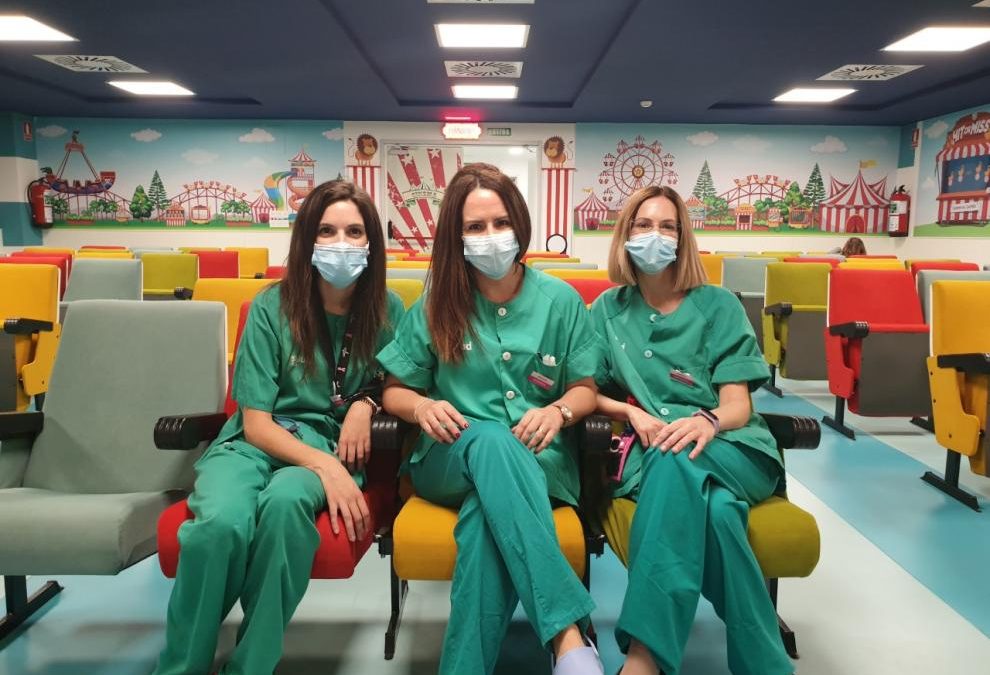
The project is inspired by the work carried out in a Hospital in Manacor (Mallorca) and aims to serve as an example for other smaller hospitals.
With the objective of reduce anxiety and fear of undergoing surgery, and also contribute their "grain of sand" to the humanization of these spaces, a team of operating room nurses from the Miguel Servet Hospital of Zaragoza launched a research project two years ago that has won the hearts of families and children who are going to undergo surgery.
"We are happy because it is something that we wanted to do from our personal experience, and we have seen that The Aragonese families for whom the workshop is held leave delighted, regardless of what the results are later," says researcher María Alonso, one of the promoters of this project, who studies through different workshops the effectiveness of the non-pharmacological techniques to reduce anxiety in children who are going to undergo surgery.
The idea is inspired by the work of a group of colleagues from the Nursing area of the Manacor Hospital, Mallorca, with whom this healthcare company had the opportunity to coincide at a Pediatric Anesthesia Congress held three years ago. In this center - Alonso says - its professionals use these techniques daily to reduce anxiety in children who are going to undergo surgery: they perform workshops With them and their families, they prepare them psychologically for the day of the operation and in this way they are able to face the day of surgery more calmly. "When they told me what they were doing there, I really liked the idea, and we thought about it until we found the formula to be able to do it here. with a small group of patients. Implementing it in Servet is complicated because a large number of children are operated on (there are about 2.700 interventions per year). But we believe that if the results are good at least can serve as an example for other smaller hospitals"confesses María, who does not lose hope that one day, when the situation improves, the health authorities will provide more resources to this reference hospital in Aragon and allow them to extend their project to all the children who are going to undergo surgery.
Scientific evidence shows that the prior exposure to face mask that the anesthetist uses in the operating room prevents children from rejecting it at the time of induction. Furthermore, these researchers point out that previous studies on this topic confirm that the parents' state of nervousness or tranquility also influences how minors manage their emotions before undergoing surgery. "By launching this project We decided that we wanted to train parents and resolve any possible doubts they may have about the surgical process, and in turn with the children carry out a playful workshop where we could show them the plant, the operating rooms and the material that we would later use with them in a fun way," says Carcavilla.
Within the framework of this project, Josune Betrán, María Alonso and Sara Carcavilla They are responsible for accompanying and guiding families so that they face the fear of pain and the unknown with less anxiety. "Those two issues are key. Children often do not know the severity of their diagnosis. It's more about having to separate from your parents., who don't understand it, and ask where mom and dad are, and why aren't they coming," they say.
When everyone wants to be part of the 'case' group
To date, this team of surgical nurses has already managed to recruit More than 100 families from all over Aragon, with the collaboration of the supervisor of the Servet research area, Delia Gonzalez, and the Otorhinolaryngology consultations and its head of service, Dr. Eugene Vicente. The nursing staff of the Pediatric Surgery ward and all the operating room staff of the Children's Hospital also participate in the study. For its part, the group of statistics of the CIBA takes care of giving randomness to recruitment, since not all registered children benefit from the workshop.
Last Saturday, December 11, six randomly selected families attended one of these sessions with their children. Sara and Josune are in charge of accompanying the children during the visit, while María directs the parents to the assembly room to resolve any remaining doubts about the surgical process. "The children come delighted, and since they are also given all the material we play with - the masks, the stickers, a splint with which we hold the track... then at home they practice with that, and we also give them a little book," says Betrán. The "critical" moment for the little ones always occurs at the entrance to the operating room, when they have to say goodbye to their parents. However, this previous recreational experience allows them to take away a different memory. "In the workshops We also teach them the dropper, but since we put it on them with the little plastic that is the route, without puncturing or anything, they don't get scared. We pour water with glitter on them, we tell them that there is the dream they are going to have, so that it comes true. And so we left them for 15 days thinking about something nice. In this way, at the moment of the puncture we have made them aware that it is not that much, and on top of that it is what they remember most," says Betrán.
At the end of the workshop, all children are given a "homework" booklet to reinforce what they have learned, and they are also explained what will happen in the coming days, when they are summoned again to undergo surgery. "In the booklet there are exercises of all kinds. One of them invites the children to join the drawing of a mask with dots so they can see that underneath it there is a smile"he specifies.
The families, for their part, are delighted with the work of these professionals and assure that they would like to see it implemented beyond the study with this small group. "I loved it, and I hope the child will also be calmer on the day of the operation. I would recommend it for more families and of course it should be mandatory before facing an intervention, so that parents and children are calmer," says Radinela, the mother of a girl who is going to undergo surgery.
Jesus, the father of a child with ADHD who attended the last workshop, also views the initiative favorably and advocates that it be maintained beyond this experiment. "It seems very positive to me because we think that for children, by relating to medical processes in a playful way, It will be much easier to face the day ahead, which is a nervous day. I think it will help families. and the little ones to go through this ordeal in a gentler way. And from my point of view, the most correct thing would be for it to be established," he concludes.





