
Blood group A increases the risk of coronavirus and 0 reduces it
22 June, 2020
They confirm that the loss of smell and taste is a symptom of covid-19
22 June, 2020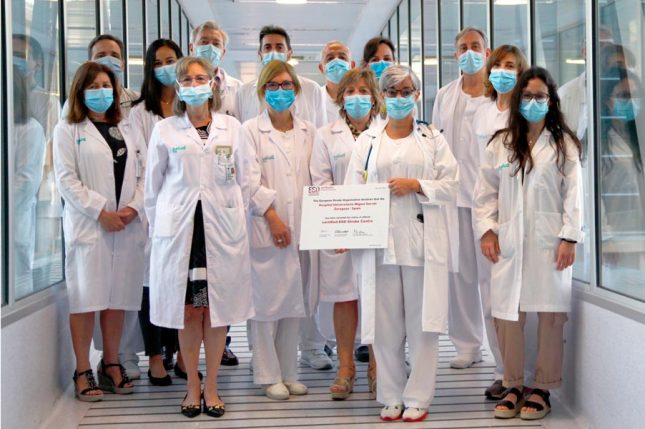
According to the head of the Servet Stroke Unit and clinical coordinator of the Aragon Stroke Plan, neurologist Javier Marta, this accreditation "represents a guarantee that quality care is being offered to all of Aragon."
The Miguel Servet University Hospital in Zaragoza has achieved certification by the European Stroke Organization (ESO) as a center specialized in stroke care, which thus recognizes it as a reference center.
According to the head of the Servet Stroke Unit and clinical coordinator of the Aragon Stroke Plan, the neurologist Javier Marta, this accreditation "represents a guarantee that quality care is being offered to all of Aragon."
A stroke is a cerebrovascular accident that occurs when an artery that goes to or belongs to the brain ruptures or becomes obstructed, preventing the blood and oxygen it was carrying from reaching the brain cells and, therefore, the tissue. The affected person suffers, stops functioning, and eventually dies.
For every minute that passes since the stroke occurs, two million neurons are lost, so reaction time is key, explains the Government of Aragon in a press release.
In this way, quickly and adequately caring for the patient clearly influences mortality and, in the event that the patient survives, it has an impact on the severity of the consequences such as disability or dementia, the aforementioned sources point out.
In Aragon, with 1.300.000 inhabitants and an area of 47.000 square kilometers, the dispersion of the population and its aging make care difficult, which is why in 2009 the Stroke Plan was launched, whose main objective is that any citizen anywhere in Aragon has access to rapid and quality healthcare, which has allowed mortality to be reduced by 40% in this period.
In 2016, another turning point in stroke care occurred with the Servet approval of thrombectomies, a very efficient, but highly complex, neurointerventional technique that allows the thrombus that blocks blood circulation to be removed.
"Being able to offer these techniques 24 hours a day, 7 days a week is a challenge and proving that we do it and we do it well, is a great satisfaction," says Marta.
To obtain the aforementioned certification, it means having everything organized from the first call to the emergency service to rehabilitation and returning home.
"It has involved a lot of work - continues the coordinator - because it has involved shaping everything we do, structuring it, reviewing the entire healthcare chain and the protocols, but it also means being on the map of accredited centers, both in Spain (there are 10 and we have been 11) like in Europe".
Accreditation also implies a certain volume of activity and demonstrating a certain quality of care and this "has an important impact in terms of research, collaborations, shared records. It gives us reputation and visibility," concludes the specialist.
At the Miguel Servet University Hospital alone, around 2019 stroke patients were treated in 750 and 676 patients were admitted to the Stroke Unit.
Throughout Aragon, the registered number of strokes annually is around 2.500 cases, about 175 thrombectomies and more than 260 fibrinolysis are performed.
At Servet, care for patients with stroke involves the involvement of numerous services: Anesthesia, Primary Care, Cardiology, Nursing, Physiotherapy, Neurointerventionism, Neurology, Neuroradiology, Neurosurgery, 061, Rehabilitation and Emergencies, in alphabetical order.
However, Marta assures that "the results belong to everyone, since a patient from Barbastro, for example, cannot be treated without the involvement of more than 30 professionals. Therefore, accrediting the reference hospital means that we really work as a network and are at the same time service of all".





