
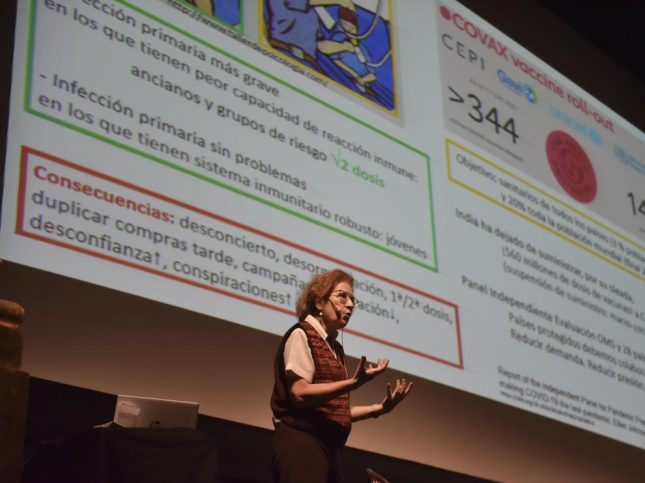
"Unvaccinated people have the same risk of ending up in the ICU or dying as they did a few months ago"
October 14, 2021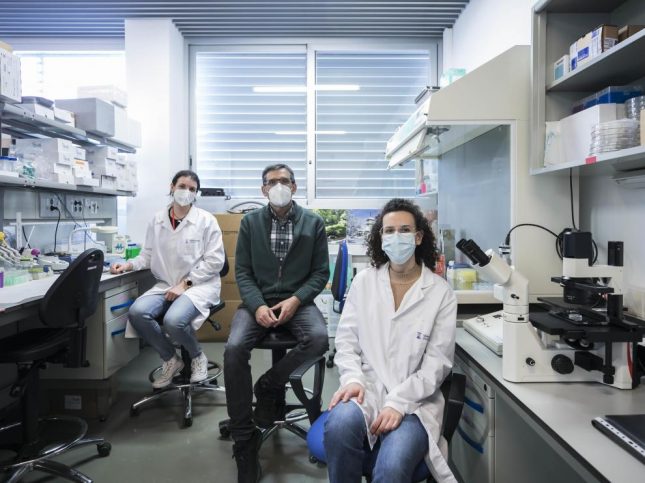
An Aragonese team designs new strategies to attack solid tumors resistant to immunotherapy
October 18, 2021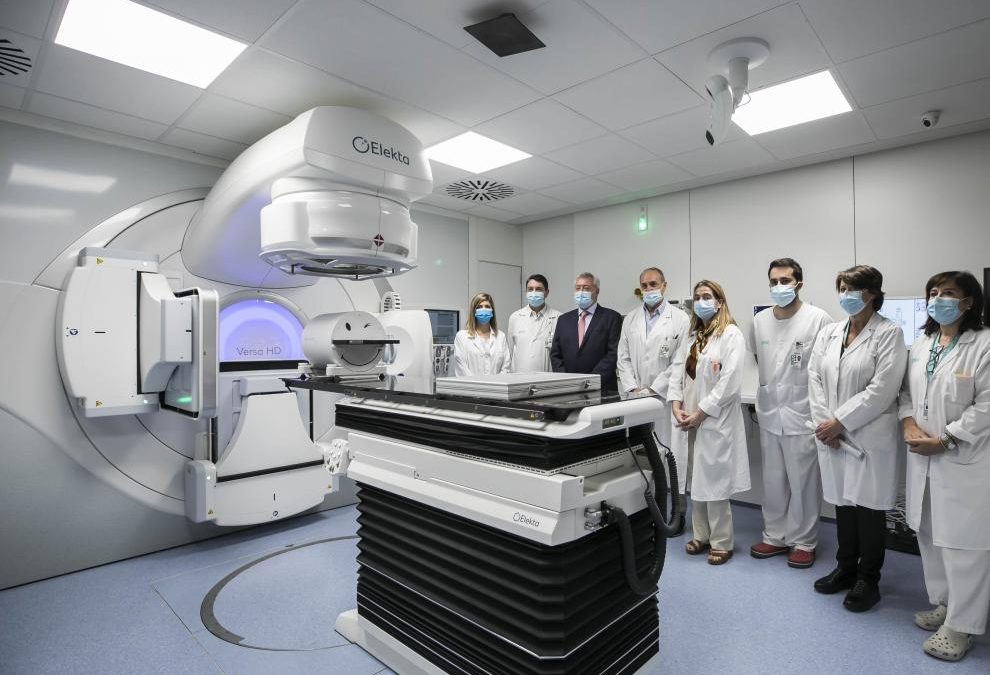
This state-of-the-art device, in which 2,7 million euros have been invested, has been donated by the Amancio Ortega Foundation
The Miguel Servet Hospital in Zaragoza now has a new electron accelerator, the sixth in Aragon, in which 2,7 million euros have been invested, donated by the Foundation Amancio Ortega. Thanks to the agreement with this entity, almost 90 pieces of equipment have been financed for the treatment of cancer patients.
This latest technology device, which is added to the two that already exist in this hospital, has been installed in a conditioned bunker on floor -1 of the hospital center, where it was received on March 21, 2020, just a week after declaring the state of alarm. With this device, the Multihospital Clinical Unit of Radiation Oncology of Aragon (Ucmora) now has six accelerators, distributed between the Clinic and the Servet, to offer radiotherapy treatments to cancer patients. Specifically, what has been installed at Servet is a linear electron accelerator for stereotactic radiotherapy model Versa HD from the company Elekta.
The current plan is to have eight accelerators within 2 years. "There will be a renovation both in quality and quantity" thanks to the European Funds, which will allow four devices to be brought to Aragon: two will be for the renewal of equipment and another two, which will allow offering "proximity" because "Patients from Huesca and Teruel will have radiotherapy treatment much closer."
The commissioning of the third Servet device includes the update of another Elekta accelerator, which will stop providing service at the end of October during a maintenance period for its renewal and will be active again at the beginning of the year. For Martín Tejedor, the update of this second device "will allow it to be converted into a device with similar characteristics to the new one."
The head of Physics and Radiological Protection of the Michael ServetusJosé Antonio Font, added, at the same time, that "one of the peculiarities of the new device is that instead of administering the treatment at fixed angles, it is done in volumetric modulated intensity arcs" and this implies that the treatment is "faster and more precise". "It will give us quantity and quality," she stated.
Each Ucmora accelerator treats between 550 and 700 patients a year, Depending on the type of tumor and its prognosis, Martín Tejedor has assessed, a number of sessions are established that can range from one to forty. Its entry into operation is gradual: the first three patients received treatment on September 29 and, progressively, the number is increasing until reaching approximately 40 daily.
"During the pandemic, cancer has not stopped," adds Martín Tejedor, "and the incidence of cancer unfortunately does not decrease". Screening campaigns mean that there are more and more cancer patients and the indications for radiotherapy are increasing. "We have not noticed a drop" due to the slowdown in health activity due to the waves of coronavirus: "It was noticed in the peak period of covid, because there was a certain fear of going to the emergency room, that the patients who came arrived with tumors locally more advanced. It caused some patients to be diagnosed a little later, but it did not reduce the number of patients.
The work to install the accelerator has been "complicated" because it has been necessary to enable a room that, for years, functioned as a warehouse and that in the 80s of the last century housed the first accelerator in Aragon and one of the first in Spain.





