
A technological platform will be able to reproduce the functions of human organs in the laboratory and reduce animal experimentation
3 December, 2020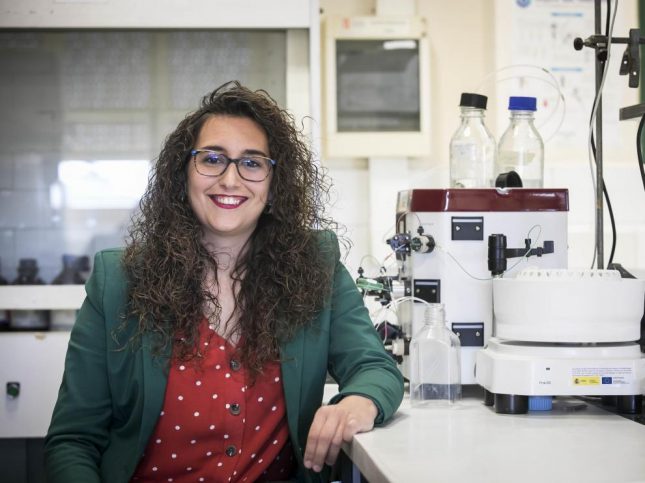
Ana Pilar Tobajas de la Fuente: “If you investigate, you know that experiments never work out the first time”
4 December, 2020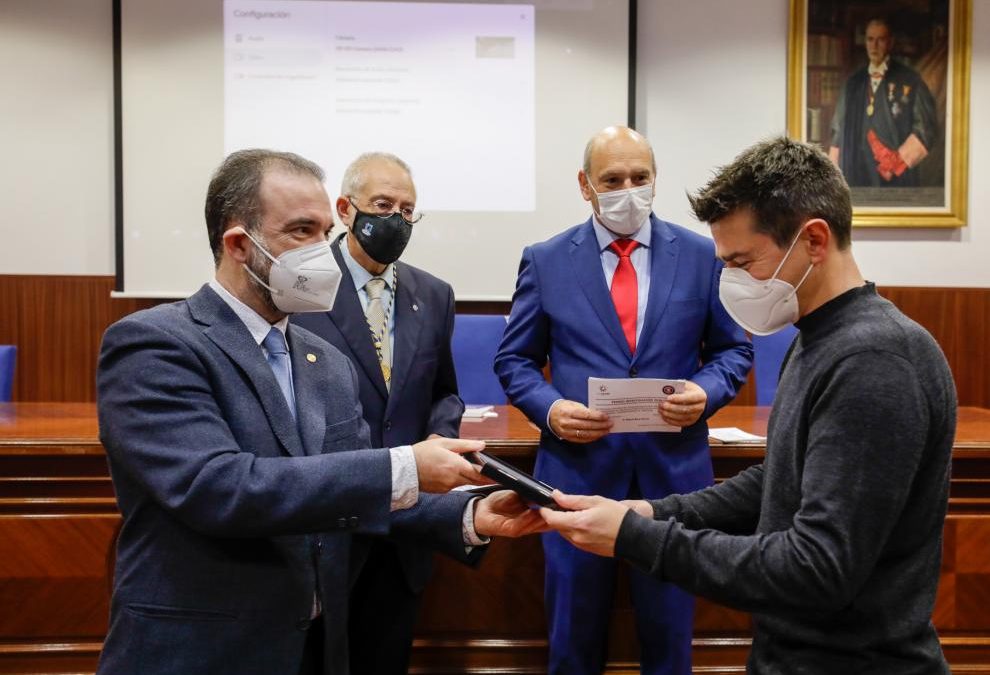
The winner is a researcher at the Institute of Chemical Synthesis and Homogeneous Catalysis (ISQCH).
Miguel Baya, researcher at the Institute of Chemical Synthesis and Homogeneous Catalysis (ISQCH), has been awarded this Wednesday with the research prize of the Royal Academy of Sciences of Zaragoza (RACZ) 2020 in the Chemical Sciences section.
During the award ceremony, Baya presented his research work to the president of the RACZ, Antonio Elipe Sánchez, and to the general director of Grupo San Valero, César Romero Tierno, who were accompanied by the secretary of the Academy and the dean of the Faculty of Sciences, Luis Morellón, reports the University of Zaragoza in a press release.
Miguel Baya has a degree in Chemistry (1997) and a PhD in Sciences (2002) from the University of Zaragoza. During his formative stage he worked in the groups of professors Miguel A. Esteruelas (UZ), Rinaldo Poli (Université de Bourgogne, Laboratoire de Chimie de Coordination-CNRS) and Agustí Lledòs (Universitat Autònoma de Barcelona).
In 2006 he rejoined the University of Zaragoza with a contract through the Ramón y Cajal program, later stabilizing as PCDI (2011) and since 2020 he has been a full professor in the Department of Inorganic Chemistry.
Likewise, it belongs to the Institute of Chemical Synthesis and Homogeneous Catalysis, ISQCH, a joint institute between the Higher Council for Scientific Research CSIC and the University of Zaragoza.
The researcher is co-author of more than 55 scientific publications and one patent, and has maintained close collaboration with BSH for several years.
His research interests focus on the development of organofluorine complexes of transition metals, the application of hydrogen-bearing organic liquids aimed at mobile applications, and the study of complexes with metal-metal bonds, trying to combine experimental and theoretical perspectives in all cases. .
His transfer work focuses on the analysis of weaknesses caused by the interactions of the chemical elements present in the manufacture of glass-ceramic plates, and on the development of innovative solutions that solve these problems.
The Royal Academy of Sciences of Zaragoza gives its awards in four categories corresponding to the sections of Exact, Physical, Chemical and Natural Sciences. Every year the awards are given for two of these categories, which, in 2020, are Chemistry and Natural Sciences, which went to Blas Lorenzo Valero of the Pyrenean Institute of Ecology, IPE (CSIC).
These are awards to young researchers linked to Aragon, due to their residence, origin or activity and who have stood out for their career and research results.





