

The 4D PICTURE project receives the 'Patient Experience' award at the 24th National Congress of Hospitals and Healthcare Management
13 June, 2025
'I HumanizAR and CuidAR Awards for Aragon': deadline: June 24
19 June, 2025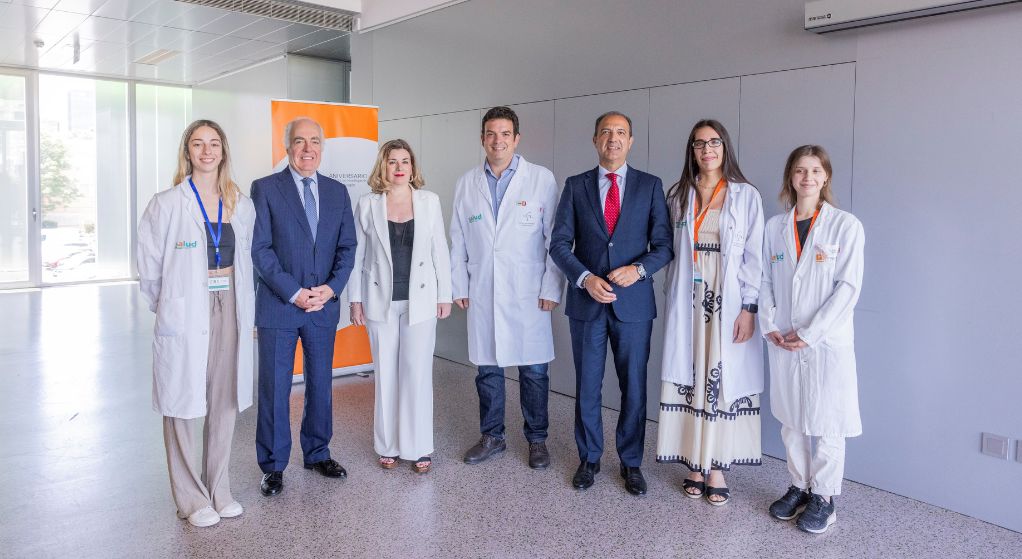
This research, led by the Molecular Oncology Group of the IIS Aragón, aims to improve the effectiveness of chemotherapy while significantly reducing its adverse effects.. The signing of this agreement reinforces the commitment of both institutions to the advancement of cancer research in Aragon.
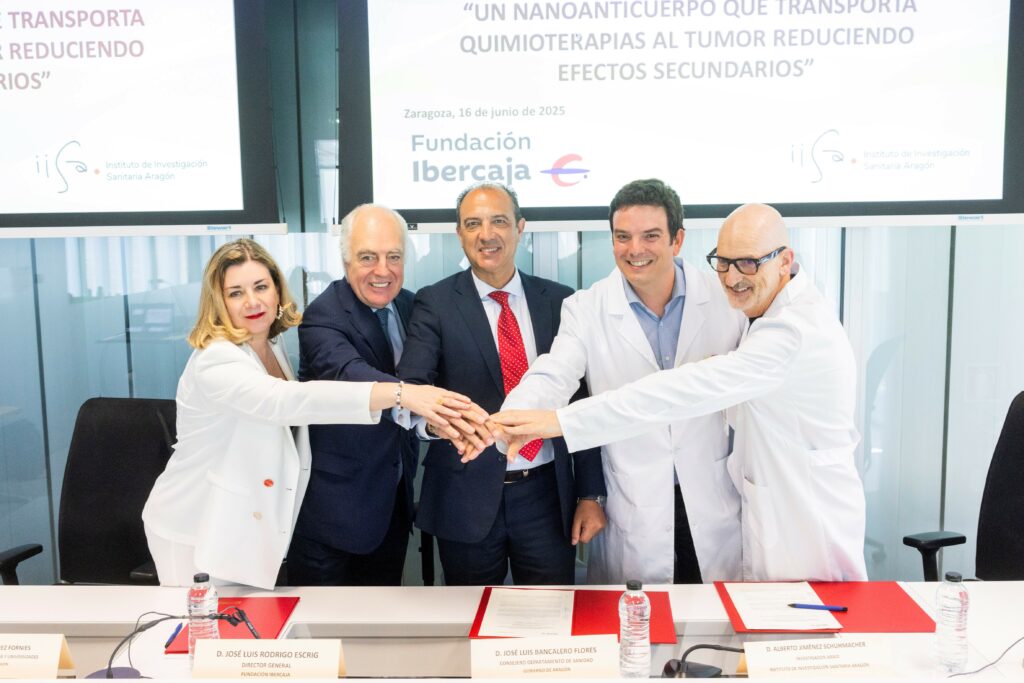
The Aragón Health Research Institute (IIS Aragón) and the Ibercaja Foundation have signed a collaboration agreement to support the development of the "Sara" research project."A nanoantibody that transports chemotherapy to the tumor, reducing side effects," led by the Molecular Oncology Group of the IIS Aragón under the direction of ARAID Researcher Alberto J. Schuhmacher.
The signing of this agreement, which took place today at the Biomedical Research Center of Aragon (CIBA), The event was attended by the Minister of Health of the Government of Aragon, José Luis Bancalero, and the Minister of Employment, Science and Universities, Claudia Pérez. They were also joined at the event by José Luis Rodrigo, General Director of the Ibercaja Foundation; Ángel Lanas, Scientific Director of the IIS Aragón; Óscar López, Executive Director of the Institute; and Alberto J. Schuhmacher, ARAID researcher at the IIS Aragón. This agreement will make it possible to promote a groundbreaking research (“compass chemotherapy”) that could improve the effectiveness of these treatments while significantly reducing their adverse effects.
El Minister of Health, José Luis Bancalero Flores, has highlighted the work of the Aragon Health Research Institute in the development of top-level biomedical research and innovation in the Autonomous Community, as well as its translation to the healthcare system and to patients. This impacts the improvement of the quality of life of the Aragonese. Bancalero emphasized that this is precisely the objective of the oncology research project that the Ibercaja Foundation will finance, since it will impact reduce the side effects of chemotherapyThe counselor congratulated the principal investigator, Alberto J. Schuhmacher, and wanted to emphasize that The IIS Aragón maintains more than 450 active clinical trials, of which 250 are in the oncology field.
For its part, Pérez Forniés, Minister of Employment, Science and Universities, She congratulated the research group, headed by Alberto J. Schuhmacher, and expressed her pride in the work and talent of the researchers we have in our community. "From the regional ministry We are committed to research as one of our priority axes to achieve advances like those we have seen today. Advances that significantly improve the quality of life of the Aragonese," said Pérez Forniés, emphasizing the value of talent and effort made by the Department to retain and attract research talent. "We have implemented innovative talent acquisition programs, but if we are able to attract scientific excellence to our region in any way, it is thanks to the ARAID Foundation. By 2025, we will reach the maximum number of researchers on its staff, as in just two years we will have incorporated 20 ARAID researchers, representing 30% of the total research staff."
Reduce the side effects of chemotherapy
The “Sara” research project, developed by the Molecular Oncology Group of the IIS Aragón, is based on "nanoADCs", an innovative technology that uses nanobodies derived from dromedaries to precisely target highly toxic chemotherapies directly to the tumor. Unlike conventional antibodies, these nanobodies are smaller, penetrate the tumor better, and are quickly eliminated from the body if they don't find their target. "Some very effective chemotherapies can't be used because they're too toxic to the rest of the body. We attach them to a nanobody that transports them directly to the tumor. Once there,"If the nanoantibody adheres to the tumor cell, it releases the chemotherapy inside, affecting only the tumor and nearby cells, without damaging healthy tissue. Furthermore, what doesn't bind to the tumor is rapidly eliminated in the urine in an inactive form, which improves the treatment's efficacy and reduces its toxicity. "We're in the early stages, but we're confident we've laid a solid foundation that will allow us to run ahead," Schuhmacher emphasizes.
The general director of the Ibercaja Foundation, José Luis Rodrigo, has highlighted the importance of supporting research. “At our organization, we have always considered supporting society and being there for people as our main goal. By collaborating with this innovative project focused on cancer research, we are fully achieving this goal, becoming part of a proposal with which the living conditions of many people can be saved and improved"He said.
This agreement signing was accompanied by a visit to the Molecular Oncology Group's laboratory at CIBA. Within this framework, Schuhmacher also emphasized the importance of social commitment to research"Science is everyone's responsibility. It's essential to raise awareness in society to support research. I hope the Ibercaja Foundation's example will be followed by more institutions and companies so that Aragonese research can accelerate and transform society more quickly."
This collaboration represents a step forward in oncological research in Aragon and reinforces the commitment of both entities to the development of new therapeutic strategies that improve the quality of life of patients.





