
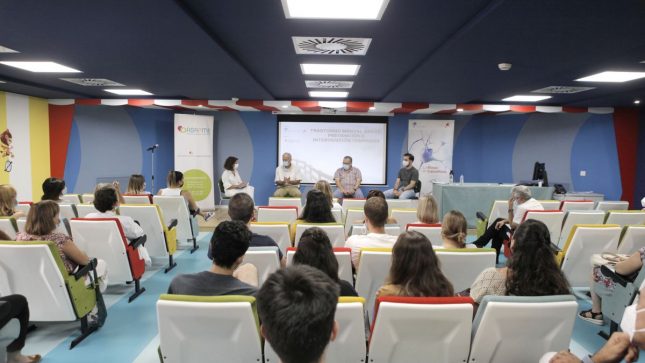
Aragón psychiatrists warn of more serious mental health cases
September 10, 2021
Extreme health control over the Mu variant
September 13, 2021
The main lines of research of this new CSIC institute, located on the campus of the University of Alcalá de Henares, have just been announced.
The Higher Council for Scientific Research (CSIC) has announced the research strategies of the Cajal International Neuroscience Center (CINC-CSIC), which It will cover the fundamental aspects for understanding the brain. The new center, located in the Interdisciplinary Research Center of the Scientific Campus of the University of Alcalá (UAH), will be inaugurated throughout 2022.
The institute's website has already launched a call for hiring between 20 and 30 heads of research groups. It invites talented scientists – and the ambition to establish a competitive research program – to join CINC. Proposals will be received from both CSIC and external personnel, the text states. The call “strongly recommends that women and minorities apply.” The candidates, who will be selected “by an international panel of leading neuroscientists,” are expected to be named during the second half of 2022 and early 2023.
As the president highlighted in her speech, “The study of the brain is one of the great challenges of science due to the complexity that entails unraveling its fundamental mechanisms.”
This center, Menéndez has pointed out, “was born with the ambition of becoming a global reference in neuroscience research and basic knowledge of the brain. It is one of the great bets of our institution to promote and strengthen neuroscience in Spain and maintain it as an international reference.”
Deepen your understanding of the brain
The CINC has the purpose of creating a multidisciplinary research space of high level and international competitiveness. His lines of research will include the fundamental aspects for understanding the brain aligned with the Brain, Mind & Behavior White Paper of the CSIC 2030 Scientific Challenges.
CINC's research fields will be articulated around five scientific axes: brain development and maturation, physiology and plasticity, brain aging, computational and systems neuroscience, and translational neuroscience. The center's website also indicates that "selected candidates are expected to contribute to the definition of specific research programs."
In Lerma's opinion, “the recent pandemic due to SARS-CoV-2 has revealed the need for fundamental knowledge in unpredictable areas to address unexpected health crises. This fact is particularly evident in the area of neuroscience, where basic knowledge of the brain is still far behind that of other organs and systems.
According to this neuroscientist, "there are, at least, three exceptional reasons to stimulate and enhance the study of the brain: This is the most complex structure known. It generates all our thoughts and behaviors, and when it malfunctions it causes hundreds of disorders at all ages, representing a greater economic burden on society than cancer, cardiovascular disease and diabetes combined.
The objective of this center is to host national and international groups of excellence to carry out high-impact research projects in the field of neurosciences. Will be open to collaboration with hospitals and other campus groups, and in postgraduate and doctoral programs at the University of Alcalá de Henares, reports the CSIC.
Spain is recognized worldwide in neuroscience, not only because Santiago Ramón y Cajal is considered the founder of modern neuroscience, but because the level of this subject in our country is above European standards.





