
15th Edition of the "Aragón Investiga Awards"
23 June, 2025
Aragon allocates 159.000 euros in mobility grants to 33 predoctoral researchers in training.
25 June, 2025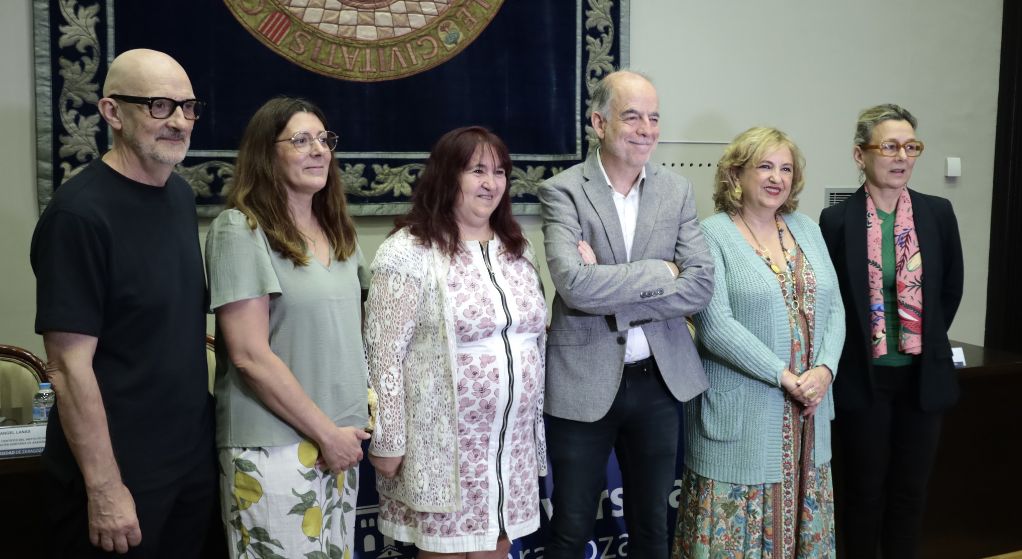
The scientist from the University of Zaragoza at the INMA, a joint CSIC-Unizar center, and at the IIS Aragón, will research for 5 years on how to direct nanoparticles with drugs to the tumor in a more effective way.
The professor Jesús Santamaría receives his third Advanced Grant, the most prestigious European support for research excellence.. With higher funding than usual, €3,1M, the scientist from the University of Zaragoza at the INMA, a joint CSIC-Unizar center, and at the IIS Aragón, will research for 5 years on how to direct nanoparticles with drugs to the tumor in a more effective way..
This innovative proposal in nanomedicine focuses on more effectively directing the particles therapeutic towards the tumor and will be held over the next five years from the Aragonese capital. It has been obtained by Jesús Santamaría, Professor of Chemical Engineering from the Zaragoza's University, and member of the Institute of Nanoscience and Materials of Aragon (INMA), a joint center CSIC – UNIZAR, and the Institute of Health Research of Aragon (IIS Aragon), and is her third Advanced Grant, the most prestigious European support for excellence in research.
In fact, with the ERC Advanced Grant ROMEO, Santamaría it is situated in the research podium in Spain, along with others five scientists (Jordi Galí Garreta, Javier Jiménez Sendín, Maciej Lewenstein, Luis Serrano Pubul and Niek Frans Van Hulst), who have obtained their third Advanced Grant, something exceptional, taking into account the extreme competitiveness of these projects.
This important financial support obtained by Santamaría, one Leading European researchers in the field of nanomaterial synthesis and applications, is part of the 281 exclusive Advanced Grants granted by the European Research Council of the Horizon Europe programme, endowed with a total amount of €721M, and which have been selected from among the 2.534 proposals presented in 2024. Of the funded initiatives, 14 are Spanish and of these, 4 correspond to areas of Science and Engineering, among which is ROMEO.
The grant program funds research work in Europe selected through a highly competitive process based solely on the novelty ("frontier research") of the project and the scientific excellence of the researcher, so getting an ERC grant is one of the greatest recognitions at European level to which a researcher can aspire, as highlighted today by the authorities at the presentation of this project, which took place in the Auditorium. The event was attended by the rector of the University of Zaragoza, Rosa Bolea; the delegate of the Higher Council for Scientific Research (CSIC) in Aragon, María Jesús Lázaro; the vice-rector for Scientific Policy at Unizar, M. Pilar Pina; the director of the INMA (Joint CSIC-Unizar), M. Elena Gálvez; and the scientific director of the IIS Aragón, Ángel Lanas.
With this new concession, The University of Zaragoza goes from 19 to 20 projects ERC since 2009, with an amount total amounting from €31.7M to €34.8M, distributed among the following categories: Proof of Concept, 3; ERC- Starting,7; ERC-consolidator, 4; ERC- Advanced, 5 and Synergy Grant, 1.
Of this total funding, Jesús Santamaría has raised a total of €14M in 7.45 years among its three ERC projects European Research Council Advanced Grant:
2011: Hector Project, financed with 1,85M of euros for develop a novel reactor with catalysts capable of selective heating using microwaves.
2017. Cadence Project, endowed with almost 2,5 million euros, he considered tumor as a catalytic reactor all with wreck it since interior, generating toxic products in situ. To this end, catalysts capable of be activated selectively.
2025. ROMEO Project: Cracking the code on tumor targeting with nanostructures: competitive kinetics and extracellular vesicles (How to crack the code for targeting tumors with nanostructures: Competitive kinetics and extracellular vesicles), 3.1M €.
“Nanomaterials do not reach the tumor in sufficient quantities”
After more than a century of research efforts, the cancer remains a huge health problem, causing nearly 10 million deaths each yearThis was expected to change with the arrival of the nanomedicine, following the launch of the first nanoformulation (Doxil) in 1995. However, 30 years later, promising progress of nanomedicine have not been able to be transferred to the clinic in a convincing manner.
“The reason is clear,” says Jesús Santamaría.It's not that nanomaterials don't work, it's that they don't reach the tumor in sufficient quantities.: On average, less than 1% of systemically administered nanoparticles reach the tumor, in fact, most (sometimes up to 95%) end up in the liver, hijacked by macrophages residents in the sinusoids." Therefore, achieving escape capture by macrophages and directing the particles towards the tumor becomes the most important topic in nanomedicine against cancer.
The strategies of the European ROMEO project
The European ROMEO project has two strategies to achieve this goal: On the one hand, they are going to evaluate capture kineticsMaking different nanoparticles compete to see which ones are best able to avoid capture by macrophages and which ones, on the contrary, are preferentially captured. To do this, on the one hand, they will Design “decoy” particles that saturate macrophages before delivering therapeutics. On the other hand, ROMEO will use the group's experience in extracellular vesicles (EVs) to use them as vectors and get a more effective targeting of the tumor.
EVs are vesicles that emitted by almost all cells of our body, and that They are essential in intercellular communication. In ROMEO we will use a very important property of EVs, which is that they are capable of preferentially recognizing the cell from which they originate. That means that EVs from tumors can be ideal vehicles for carrying therapeutic nanoparticles to those same tumors.The challenge is loading them with nanoparticles without disrupting their recognition properties, but the group is currently developing various tools to achieve this.
A budget that exceeds the established maximum
ROMEO has a 3.121.375 euro budget and a deadline of execution of 5 years in the Making. It will be developed at the INMA and IIS Aragón facilities, by a team composed of five researchers of the University of Zaragoza members of the NFP group (J. Santamaría, V. Sebastián, JL Hueso, M. Sancho-Albero and A. Martín Pardillos) y seven additional researchers (three postdoctoral, three predoctoral and one technician), who will be contracted for the project, between researchers from chemistry, biology and materials profiles. In addition, given the multidisciplinary nature of ROMEO, we will collaborate with the groups of Drs. Ignacio Ochoa and Diego Gutiérrez, from I3A, y Antonio Monzón, from INMA, as well as with the Dr. Ibane Abasolo from IQAC-CSIC, Barcelona.
In this case the budget exceeds the maximum of 2,5 million established for the Advanced Grants because the ERC has granted additional budget for the acquisition of scientific equipment, especially a high-performance confocal microscope.
Jesús Santamaría is one of the leading European researchers in the area of nanomaterial synthesis and applications. His current research interests include development of new methods for the synthesis of nanomaterials, and applications of materials synthesized in medicine, photo-assisted catalysis, microwave catalysis, sensing by molecular recognition and nanosecurity.
385 articles published, 39 doctoral theses directed, 26 patents and participation in 101 projects, 20 of them European, including three of the prestigious Advanced Grants of the European Research Council (ERC), endorse Santamaría's career in the academic and scientific fields. Santamaría is the Principal Investigator of the NFP (Nanostructured Films and Particles) research group, and belongs to the Institute of Nanoscience and Materials of Aragon (INMA), joint center CSIC-UNIZAR, to the Aragon Health Research Institute (IIS Aragon), and the Biomedical Research Network Center for Bioengineering, Biomaterials and Nanomedicine (CIBER-BBN).
Santamaría has been director of the Samca Chair of Nanotechnology, and directs the Exobiopharma Chair of Nanomedicine. He has been Dean of the Faculty of Sciences, Deputy Director of the Unizar Nanoscience Institute of Aragon and magazine editor Chemical Engineering Journal. He has carried out postdoctoral research stays in the University of Notre Dame and the Massachusetts Institute of Technology (MIT).), both in the United States. He has received numerous awards and recognitions and is a member of the Istituto Lombardo Accademia di Science et Lettere, and the Academia Europaea, in its Division of Mathematical and Natural Sciences, Chemistry section. In 2024 he was recognized with the Aragón Investiga award for excellence “Miguel Servet”. Her passion for outreach has accompanied her throughout her research career, with the launch of various activities and her membership in the RISArchers group, stand-up comedy researchers at the University of Zaragoza.
Source: University of Zaragoza





