
AECC TALENT Grants 2026
September 11, 2025Travel grants to participate in the CNIC PhDay 2025 scientific meeting
September 15, 2025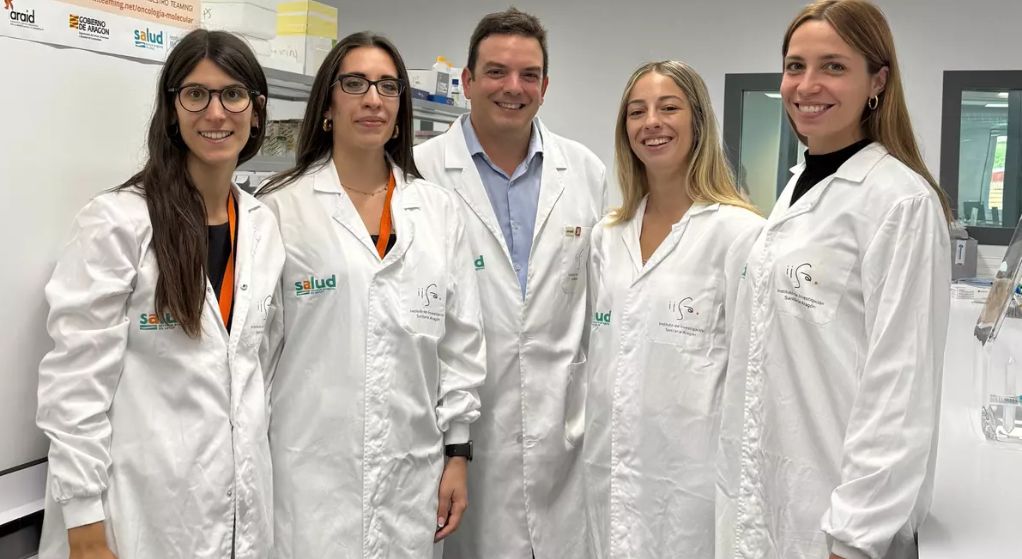
The Antonio project, promoted by the IIS Aragón, seeks specific cellular models for a tumor that in 80% of cases is detected in advanced stages.
“We have breasts. We can have cancer.” This phrase, as simple as it is awkward, is uttered by Alberto Jiménez Schuhmacher, an ARAID researcher and head of the Molecular Oncology Group at the Aragón Health Research Institute (IIS Aragón).
It speaks of a tumor that affects between 350 and 700 men in Spain each year, between 10 and 20 of them from Aragon. However, for most, it remains a nonexistent disease, a taboo that condemns patients to late diagnoses, radical surgeries, and, frequently, social misunderstanding.
It is in this context that the "Antonio Project" was born, the second in Spain and one of the few in the world dedicated exclusively to male breast cancer. This pioneering project seeks to provide visibility to patients and scientific tools to laboratories so that this tumor ceases to be a black hole in oncology research.
A scientific and social urgency
Although this diagnosis always produces fear and uncertainty, oncology is experiencing a moment of hope. Every year, advances in treatments, biomarkers, and artificial intelligence applied to early detection are announced. However, in Alberto's words, male breast cancer remains outside this progress.
"I can acquire thousands of cell lines for many tumors in repositories, but none for male breast cancer. They don't exist or aren't available. They don't exist, and they can't be an answer," he says.
Without these tools, it's impossible to advance in the initial phases of research or test new drugs with scientific rigor. As a result, men diagnosed with the disease largely receive the same protocols designed for women, despite the unique biology of male tumors.
Due to a lack of visibility, awareness of the disease among men, and early detection, 80% of diagnoses are made in advanced stages (III-IV), with spread and metastasis.
Furthermore, the lack of screening programs, coupled with the perception of "low incidence," has led to a high percentage of late diagnoses compared to women.
"Many men don't know we have breast cancer or that we could suffer from this type of cancer. This lack of awareness leads to later diagnoses, when the tumors are more aggressive. There are also no screenings for men, and we don't know how to perform self-examinations," explains the researcher.
This situation, coupled with a lower awareness of self-care in men's health, means that in Spain, 96% of men diagnosed with this condition undergo a mastectomy, compared to 70% of women. "A man's breasts are smaller, so conservative surgery is more difficult. Even smaller tumors, being next to the nipple or the pectoral fascia, require the removal of the entire gland," he explains.
In his opinion, male cancer has been considered a "rarity" for decades, and most clinical guidelines were based on experience with women, "extrapolating treatments to men without conducting clinical trials."
But this is expected to change, and to combat this reality, the Aragon Health Research Institute (IIS Aragón) and the Male Breast Cancer Association (INVI) signed an agreement in 2023 to launch the second research project on male breast cancer in our country.
'Antonio': a name that helps in research
The project led by J. Schuhmacher seeks to isolate cell lines from male breast cancer patients with the goal of developing cellular models, mouse models xenografted with tumors, and metastatic lines with tropism for certain organs to generate in vivo metastasis models. "The generation of all these models will allow therapies to be tested in preclinical phases. We will begin by evaluating the studies we have underway in the group and that are being analyzed in breast cancer samples derived from women," adds Alberto J. Schuhmacher.
More specifically, as explained by the IIS, cell lines and organoids will be isolated from primary tumor samples from male patients and can be implanted in the breast or flank of immunocompromised rats. Primary tumor grafts will then be performed if the sample allows, and once they have grown, the primary tumor will be removed and the patient will wait for metastasis to form.
Once all this is achieved, according to the researcher, these cells will be dissected, cultured, and isolated to then be grafted into the breasts of new mice or using different methods that can facilitate their implantation in target organs.
Based on this process, it is hoped to provide a solid foundation for the development of more effective therapeutic strategies aimed at preventing or treating the metastatic spread of cancer in general, and breast cancer in particular.
“Men have a Y chromosome, and we don't know if it plays a role. Just as not all breast cancers in women are the same, we can't assume that male breast cancer is identical,” he explains. Regarding the name, Antonio, the researcher explains that it was the father of a friend who died of breast cancer: “I wanted to pay tribute to him because science should be social. It's not male breast cancer, it's Antonio, Màrius, Marcos, Julio, José, Esteban…”
That personal memory connects the coldness of the test tubes with the real lives of patients. In Alberto's words, "it's not the same thing to have a cell line with a code of letters and numbers purchased from a repository as it is to know you have a sample from someone in the hospital whom you can impact." "I often cry when I see the samples we receive," he admits.
Aragon as a driving force
The IIS Aragón and the community's public hospitals offer a unique ecosystem, since, as he quips, doctors from multiple disciplines and "lab rats like me" coexist.
In terms of raising awareness, Aragon has improved after holding the 2023nd Aragonese Breast Cancer Humanization Conference in XNUMX, under the slogan "They also contribute," with specific materials on male self-examination and patient testimonials.
“Raise awareness, raise awareness, and raise awareness about this tumor like INVI does, and promote men's health like TheMoveMen does,” insists Alberto, who asserts that the stigma weighs as much as the disease itself and silences symptoms that, if detected early, could save lives.
“We have breasts. We can have cancer. If you notice a lump, a nipple discharge, or something else is worrying you, see a doctor. If you catch it early, you can avoid a serious problem. Take care of your body like you take care of your car, or even better. And, above all, talk about it,” she says.
Although the path toward greater detection and improved systems for caring for people with this disease is still ongoing, Alberto relies on the power of new technologies.
In this sense, he asserts that he is a "believer" in liquid biopsy, and that in a few years, it will be possible to detect a series of abnormalities in a blood sample, just as sugar or cholesterol levels are today.
And we must be prepared for this revolution, both professionals and society. Because, as he points out, the essence of the "Antonio" project is to research to cure, but also to speak to prevent. What is not named, does not exist. And what does not exist, ultimately, is not researched.
Source: The newspaper





