
Births of pregnant women with covid triple those of the entire pandemic in Aragon in the last month
7 February, 2022
Researchers from IIS Aragón will talk about cancer with schoolchildren from the community on the occasion of the International Day of Women and Girls in Science
7 February, 2022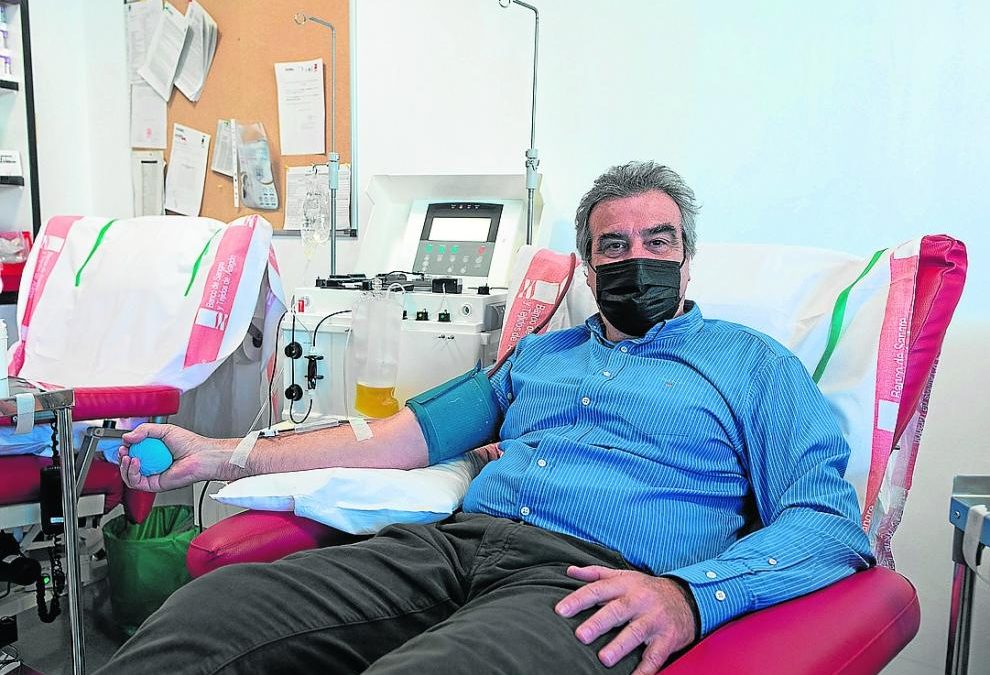
In the last year, 2.500 plasma contributions were made and 5.000 people donated for the first time.
The Blood and Tissue Bank Aragon received 44.000 donations during 2021, 2.500 more than in 2020 and 1.500 more than in 2019. Each user comes an average of twice a year and during the last year a total of approximately 20.000 showed up. In addition, 5.000 people registered as new donors during 2021.
"The donations have gone hand in hand with the evolution of the health crisis but the response at a general level has been good. It is true that they fell in schools, universities and other centers. People came to donate to the Bank," says the medical director of the Blood Bank, Dr. José María Domingo, who assures that they have not suffered any "major shortage during 2021." In December and summer, yes They had "some specific problems", but it was solved after making a series of calls.
The deadlines for drawing blood after suffering from covid changed just two weeks ago. "Before you had to wait 28 days from the infection and now you can go when 7 days have passed since a negative test by PCR or from the disappearance of symptoms", he explains. After vaccination it is only necessary to wait 48 hours.
"The majority of plasma is sent to industry to manufacture medications for blood, neurological and hyperimmune diseases," says the doctor. The truth, he explains, is that today there is a "deficit." "More and more is consumed and it is very necessary to produce many drugs. With the donors that exist now we do not cover the needs," he insists.
Plasma is also being used in patients who suffer from covid severely. "It provides antibodies and in some cases helps overcome the disease, but not in all," he explains. Its use has varied throughout the pandemic. "It is used especially in immunosuppressed patients. At first there was more demand, then with the vaccines less and "Now that serious cases are also being registered, they also ask a lot of us.", he emphasizes.
More than 10 years in the Bank
María de Codes -nurse- and Yolanda Gimeno -assistant- have been working at the Blood Bank for 8 and 16 years, respectively. "I started when they opened and we thought it wouldn't last long because hardly any donors came," Gimeno recalls. Most days they received only six people. "The day you showed up, 11 donors seemed outrageous to us," he points out. Over the years, the panorama changed. "Before we were bored and now we don't get there," she emphasizes.
"Five years ago we noticed a sudden change and many people began to cheer up," explains the nurse. Of every 30 donors, six are apheresis. "Before this process did not exist," Gimeno emphasizes.
Dr. Domingo, De Codes and Gimeno appreciate the response of the donors in times of covid. "When we make a call, many people come and sometimes they have to wait more than an hour and no one ever protests. It has a lot of merit"explains Gimeno.
"I have been donating for 20 years and I feel especially good"
Sergio Lasierra is 60 years old and is one of the most 'veteran' donors. "I've been there for more than 20 years and I feel especially good," he explains. What started as advice from a friend became routine in a few years. "When I was young I had blood coming out of my nose regularly. They recommended I donate so that my situation would improve," he says. Soon, Not only did he discover that it suited him but he also realized the show of solidarity that this "small" gesture represented.. "It is a great satisfaction to be able to help people," she emphasizes.
After suffering from covid, in November 2020, Lasierra chose to donate plasma. "They told me about the possibility and the need that existed in the Bank and I did not hesitate"declares
Despite being self-employed, he comes quite frequently. "I close the office for a while to come, it doesn't cost anything. The apheresis process - to extract only plasma - lasts 45 minutes," he says.
The plan of Diego López and Daniel Sedal, both 26 years old, is to meet to donate and then have lunch at a bar. "Coming accompanied is a good excuse," says López, who is not the first time he has appeared at the Aragón Blood and Tissue Bank, but he is a first-time donor. "I came a while ago but since I had had surgery, I had to wait a few weeks," he explains. For his part, Sedal repeats for the third time. "I started when I was 18 because a friend told me so. I try to come every year but between one thing and another, time passes and you don't remember", he emphasizes. From now on, she adds, she hopes to attend "at least twice a year." "It's something that takes 30 minutes of your life and you know that maybe someone needs it, even yourself, or someone in your family," she adds.
Source: Heraldo de Aragón





