Cadiz welcomes 300 participants this Thursday to the largest meeting of health research managers in the country
October 1, 2026
Spain delays motherhood by six years while fertility falls by half after age 40
October 6, 2026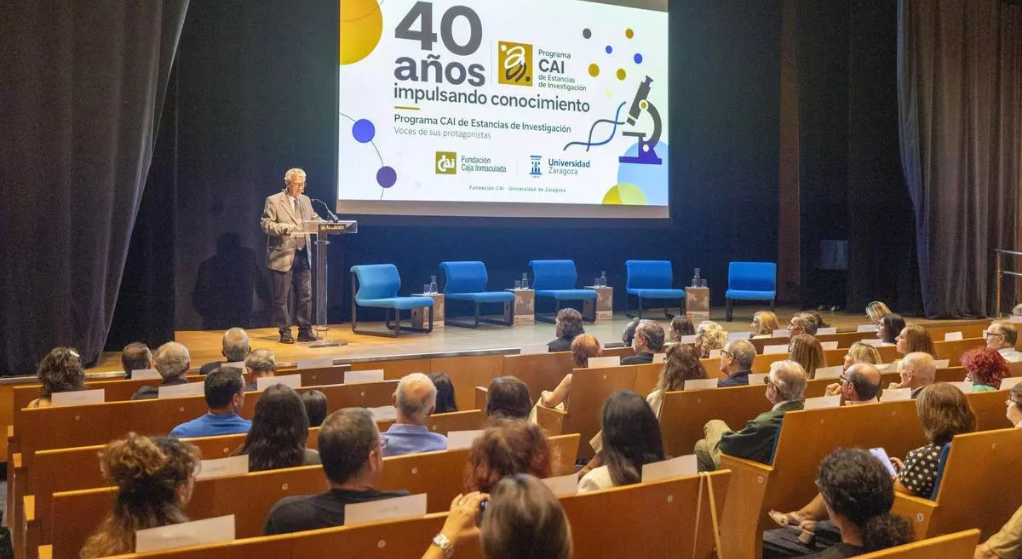
The scholarships have boosted the mobility of young scientists, and behind many of them are trajectories that today form part of the benchmark research in the autonomous community.
The CAI Foundation and the University of Zaragoza are commemorating the 40th anniversary of the CAI-Unizar Research Fellowships, a program that for four decades has supported young researchers with ties to Aragon. These grants have facilitated their mobility, training, and collaboration with leading national and international research centers, contributing to the advancement of knowledge and the development of research talent.
What began in 1986 with the Europa program stemmed from an idea as simple as it was ambitious: to allow young researchers to leave their familiar surroundings to learn, collaborate, and connect with other institutions, access new methodologies, and build scientific networks abroad. Four decades later, that initiative is now a collective story in which research advances in laboratories, hospitals, archives, classrooms, experimental fields, and technology centers across numerous countries. Because research also progresses when it crosses borders.
The rector of the University of Zaragoza, Rosa Bolea, summarizes the accumulated impact over these years as follows: "Four decades after the start of the Europa program, many of those who benefited from these grants are now leading cutting-edge research. Their careers demonstrate that investing in international mobility is investing in research talent."
The names help to gauge the scope of that commitment. Among those who have received this funding are researchers such as Conchita Gimeno, recognized in 2017 as one of the 12 best chemists in the world; Carlos Martín Montañés, who works on the development of a tuberculosis vaccine at the Aragón Health Research Institute (IIS Aragón); paleontologist Ignacio Canudo; chemist Pilar Cea; fluid mechanics researcher Pilar Brufau; and specialists such as José Ignacio Peña, Silvia Hervás Raluy, Ana Cenarro Lagunas, and Javier López Sánchez. These are just a few examples of a program that continues to evolve.
Nearly €900.000 invested and 577 scholarships awarded since 2016
Between 2016 and 2025, the program's three annual calls for applications received 809 applications and awarded 577 grants, more than 70% of the requests, with an investment exceeding €890.000. The grants, aimed at doctoral students and recent PhD graduates, allow for research stays of up to three months and cover five main areas: Agricultural Sciences; Engineering and Technology; Humanities and Social Sciences; Basic Sciences; and Biomedical Sciences. But behind these figures lies the philosophy with which the program was founded: to ensure that the knowledge acquired goes far beyond the recipient and ultimately benefits society.
According to José Ramón Auría, president of the CAI Foundation, "research should not only help us better understand why things are the way they are. It should also enhance the capabilities of researchers and doctoral students, keeping in mind that this research must benefit society and contribute to the progress of the community we have inherited."
Going abroad to return. Learning abroad to strengthen what you do at home. That has been one of the keys to these research grants. Each stay broadens a researcher's horizons, but also brings new techniques, contacts, and ways of working into the Aragonese scientific ecosystem.
40th Anniversary Exhibition
Four decades have now been celebrated with the exhibition "40 Years Promoting Knowledge," which was on display until October 3rd at the Joaquín Roncal Center in Zaragoza. The exhibition makes this institutional history more relatable through the faces, testimonies, and personal journeys of those who found in a grant a starting point for continuing their research.
However, these 40 years do not mark the end, as the program remains active. The signing of the 2026 scholarship agreement confirms the continuation of an initiative that continues to allow young researchers to undertake research stays at other institutions and in other countries. Generations, destinations, and scientific questions change, but the same idea remains: to open a door so that knowledge can travel and, when it returns, Aragon will pave new paths.
Source: The newspaper of Aragon