
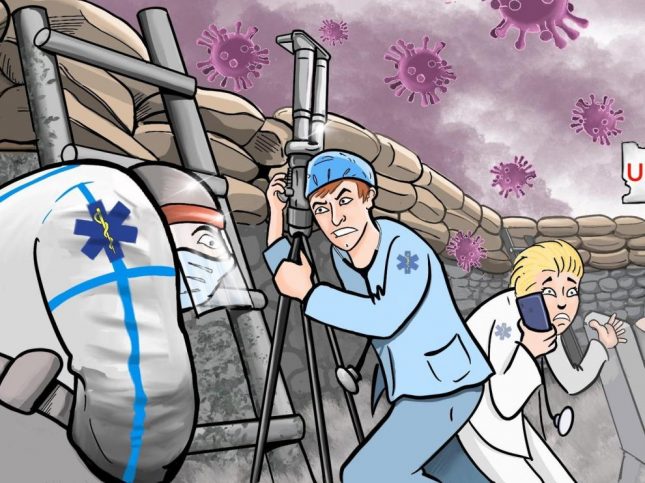
The cartoonist and doctor Rafa Marrón shows his vision on covid in Zaragoza
August 21, 2020
José María Abad: "Hospital tension could be relieved in the coming weeks"
August 24, 2020
A study points to a set of different proteins as the cause of multi-organ injuries. The author suggests that the damage could be stopped by acting on them
There are still many, many unknowns surrounding SARS-CoV-2, the coronavirus responsible for the current global pandemic. For example, why the infection, which finds its epicenter in the lungs, affects some organs more than others. Doctors and patients, in fact, report how in the most serious cases this disease can trigger multiple organ failures. Researcher Ernesto Estrada could have come up with a possible explanation for this phenomenon that, like everything that surrounds this virus, requires a slow explanation.
In an unexpected turn of events, everything indicates that proteins (and not the virus directly) could be to blame for the spread of damage through the body. This is what Estrada, an expert from the University Research Institute of Applied Mathematics of the University of Zaragoza (Unizar) and the Aragonese Agency for Research and Development Foundation (ARAID) argues, in research recently published in the journal Chaos, from American Institute of Physics.
THE 'MODUS OPERANDI'
To understand the reason for this hypothesis, we must go back to 2003, when the world experienced, although with less intensity, another coronavirus epidemic. Back in 2003, while healthcare providers were trying to deal with a surge of patients with atypical pneumonia, scientists began studying this disease that appeared out of nowhere. Already then it was observed that, although the ground zero of the infection was the lungs, in some cases affections were seen in the heart, brain, kidneys and endocrine system, among others. But once the health crisis was resolved, the question was buried in the literature. Until now, when the problem has resurfaced thanks to SARS-CoV-2.
We now know that the coronavirus enters the body and reaches the cells thanks to an enzyme, known as angiotensin 2 converting enzyme, which serves as a key to open the lock of these structures. When it manages to enter, the virus opens its capsule, releasing its genetic material (RNA) and proteins. These are the ones that, finally, interact with the proteins of the human body; changing and damaging its original structure at the same time.
«The proteins in the human body work like a network. Some interact with others to perform a certain function. If part of this network is damaged, the damage is transmitted to the others," explains Estrada. «In this case, we have observed that Covid-19 proteins enter a cell like a drunk walking through a crowd; "He advances with difficulty and avoiding obstacles," illustrates the researcher.
Once it has been clarified how a cell is damaged, it remains to be understood how this damage then spreads to other organs. Especially considering that, at a distance of cells, traveling from the lung to the brain would be equivalent to a trip of thousands and thousands of kilometers.
The answer to this mystery, recent research suggests, would be in the extracellular vesicles. «They are a kind of taxis that circulate through the bloodstream, transporting RNA, proteins and lipids. This is how the proteins damaged by Covid-19 manage to leave the lung and reach other organs, which open the door for them by not recognizing the damage," he emphasizes.





