
Researchers from IIS Aragón reveal a new inflammatory pathway that induces the development of colorectal cancer
September 22, 2020
A study reveals that continued intake of a superbug reduces symptoms of lactose intolerance
September 23, 2020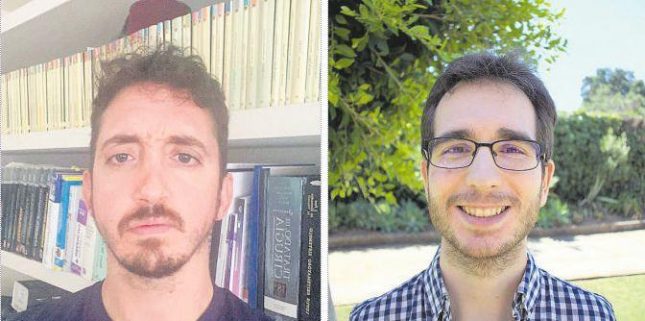
Two young Aragonese people, Borja, an internist, and Eduardo, a computer engineer, have created a software (Capillary.io) with which highly reliable capillaroscopies are performed automatically; a program that is already used internationally.
What is a capillaroscopy?
Borja Gracia: With a magnifying glass you can see the final part of the nail and thus you can observe the smallest blood vessels in the body, the capillaries, and with that you can assess the rest of the vessels that are inside the body and that It is not possible to analyze with other techniques.
Eduardo Ramos: In modern times, this technique is performed with a microscope and a computer. Photos of the blood capillaries of the nail are taken at 200x magnification. What happens is that the software used to take the images is like any other software used to take photographs, it does not do anything special when applied to capillaroscopy. With Borja's idea, we began to create software that would help the doctor see where the capillaries are and classify them by their shape, quantity and size, which indicates whether there are pathologies.
What diseases do they detect?
BG: Generally autoimmune diseases, which consist of the body's defenses attacking the body itself, such as scleroderma and dermatomyositis. However, there are more and more articles that defend the use of similar techniques to detect HIV, COPD, diabetes... In all diseases in which blood vessels are affected, significant findings can be detected with capillaroscopy.
Had these methods already been worked on in the field?
BG: When I routinely did capillaroscopy, I measured the shape and size of the vessel and the number of capillaries there were. Until now, the techniques helped to measure more easily, to quantify more easily... But not to automatically identify if there was any pathology.
ER: It was always done manually. We want the system to work automatically and for that we use deep learning techniques, something like computer neural networks, and artificial intelligence.
This must be a lot of work...
ER: We started two and a half or three years ago, back in October 2017, and we do it in our free time because we have our jobs. Once we saw that it was feasible, we started collecting images.
BG: I got images from different hospitals: Miguel Servet, Val d'Hebron in Barcelona... I don't remember how many, maybe more than 10.000, and I validated them. In this way we told the computer how to think. However, if the computer learned from me and I was doing it wrong, there was a fault. For this reason we sent the images to the ten best capillarostopists in Spain, they looked at the shots and we saw that there was an important agreement.
So, what does this new way of studying capillaries translate into?
BG: Fundamentally, in homogeneity. Until now, there was variability between observers: if two doctors perform a capillaroscopy, the percentage of correct answers in common is quite low. This means that a test in medicine in which two people do not agree at the same time is a test that leaves much to be desired.
ER: In summary, what we want to offer with our system are three key things: objectivity, efficiency -- and acceleration of the technique -- and that doctors can collaborate among themselves, to investigate to see if it can be applied to more diseases





