
Aragon will have a scientific committee to advise the Government on life after the pandemic
8 May 2020
Sore throat and muscles, loss of smell and taste, diarrhea, headaches... New symptoms compatible with coronavirus infection
8 May 2020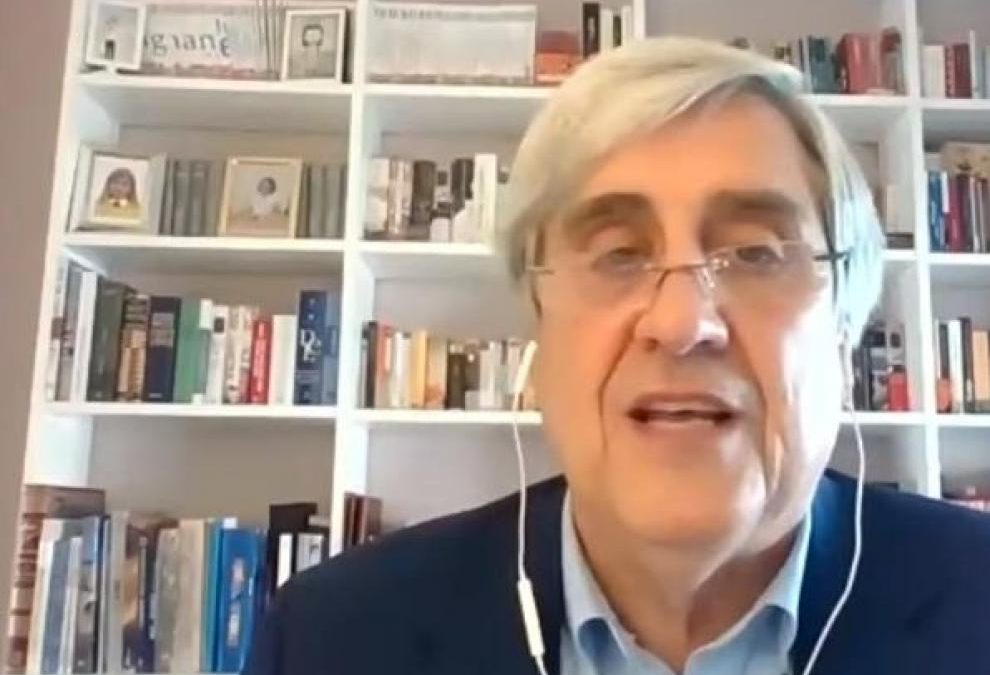
The professor and director of the Center for Encephalopathies and Emerging Communicable Diseases of the University of Zaragoza, Juan José Badiola, spoke during the presentation 'The COVID-19 pandemic', the first session of the conference cycle organized by Fundación Ibercaja, in digital format .
The professor and director of the Center for Encephalopathies and Emerging Communicable Diseases of the University of Zaragoza, Juan José Badiola, has stated that the SARS-CoV-2 coronavirus epidemic could be controlled in Spain between mid and end of June, "if things are done well." This was stated during the presentation 'The COVID-19 pandemic', the first session of the 'Challenges for the future' conference cycle organized by the Ibercaja Foundation, in digital format. Badiola has maintained that in order to control the disease, all new infections must be traced effectively and isolation must be carried out in positive cases.
The specialist has stressed that the return to normality must be a "gradual, not hasty and reversible" process, to estimate that at the moment "we are in a very good direction." Regarding a possible second wave of covid-19 in the next fall or winter, he has argued that "it is not certain that it will occur", but "it cannot be ruled out" due to the permanence of reservoirs in the country and the arrival of infected people. in other places. However, he has indicated that if this were to happen, "it will be less serious than the current one" due to the "barrier effect" of immunized people. Badiola has acknowledged that this is an "optimistic" vision, which could occur "if the virus does not mutate" and "we hope that does not happen."
The professor at the University of Zaragoza has stressed that "before the end of the year" there could be "more than one vaccine" due to the "unbridled race" that exists to obtain it, with "up to 70 research groups sponsored and supported by States and companies" with the objective of "being the first" to achieve it. In his opinion, this situation is due to the interest in gaining "prestige" and also "for money" since whoever achieves it first "will have a global clientele." In this sense, he has considered it "complicated" for both the vaccine and the treatment to be universal and generalizable.
The professor has also explained that SARS-CoV-2 has had a great expansion because "it needs to infect to survive" and, in addition, this type of coronavirus has a high multiplication capacity. "A single virus can generate thousands of viral particles and lead to a massive infection," he explained.
On the other hand, he has said that this virus has a "predilection" for the epithelial covering of the respiratory system, from the nasal cavity to the lung, because one of its structural proteins, the 'S', "has affinity" with cells. that have in their receptor the 'ACE2' protein, which allows the virus to enter the cell, so that it acts as a "lock" for the "key" represented by the 'S' protein of the virus.
Badiola has commented that "there are people who have a greater number of 'ACD2' protein", which, in turn, "is not equally distributed in the tissues of the body" and, for example, in the testicles "there is a high concentration", while it seems that estrogens could act as a protective factor, issues that, however, "are in the process of being clarified from a scientific point of view."





