Pediatric oncologist Carlota Calvo retires after 31 years working for childhood cancer in Servet
24 January 2022
Aragonese specialists create a practical guide to prevent suicide in older people
25 January 2022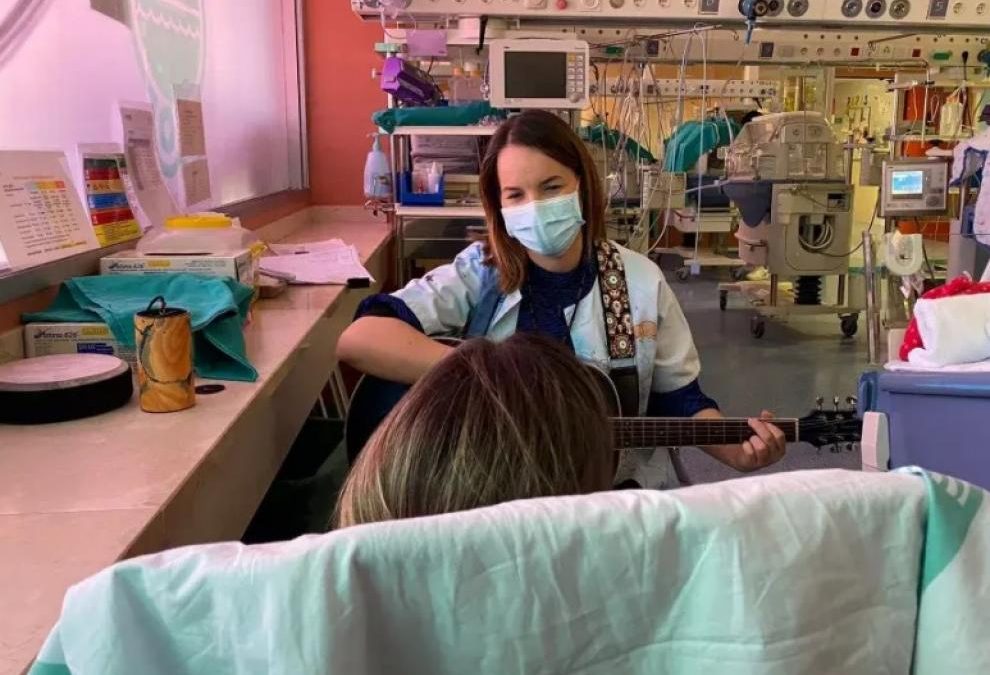
Through an agreement between the Aragonese Health Service (Salud) and the Porque Viven Foundation.
Aragón is a leading autonomous community in introducing music therapy into pediatric palliative care through an agreement between the Aragonese Health Service (Health) and the Porque Viven Foundation, dedicated to pediatric palliative care in Spain, which allows for a specialist in the unit in which these minors are cared for comprehensively.
This is Dr. Carla Navarro, a pediatric music therapist, who is part of a team made up of four health professionals - two doctors and two nurses - and a psychologist, the latter hired thanks to the collaboration of the La Caixa Foundation. This unit is a reference for all of Aragon and was created in September 2017.
Navarro joined it in October of that same year. In addition, in 2021 he has signed a specific agreement with the Miguel Servet Hospital de Zaragoza where it has introduced, through the non-profit association that has founded, 'Latir', the music therapy program for babies and children admitted to the Neonatal and Neonatology ICU, where he also accompanies those who are at the end of life.
Navarro recognizes that, although it may seem "complex", accompaniment at the end of life, right at its beginning, constitutes an "act of love" and "what is seen is not death, but life." "It's about taking care of ourselves, each one with his own tool", in his case, with music. He has also commented that for families, when they first hear the word pediatric palliatives, "their world falls apart," but when they meet the team, this type of help "they don't want to give up."
Likewise, there are other entities in Mallorca o Barcelona that recently offer this service, and has highlighted the sensitivity that has existed in Aragon in this area and the involvement of professionals since the beginning of this project five years ago.
Dr. Navarro has said that at the Miguel Servet Hospital "We do things that are not done anywhere else, such as using music therapy during the implementation of life support measures in children who are going to die", both in the Pediatric ICU and in the Neonatal ICU, as well as in the accompaniment of babies who die due to their extreme prematurity.
He wanted to emphasize that music "does not cure", but it always "cares" and provides emotional and physical benefits, relaxation and body regulation. "Medicine cannot cure everything either," He has observed, to detail that his job does not consist of singing or giving a concert, but rather working with patients and their families to be able to face a difficult situation.
He gave the example of a baby who remained irritable and who, thanks to the music therapy sessions, in response to the sound stimulus and the sung maternal voice, found moments of muscle relaxation, regulation of breathing and bonding with his mother.
He has also shared his experience with babies who synchronize the process of sucking breast milk with music. "The brain is rhythm" and music therapy allows positive neurological activation for the person due to how the brain registers and processes the auditory, motor and visual information of the musical stimulus, which activates the functioning of temporal, parietal and frontal regions.
"There are times when the ICU stops being an ICU" and becomes a place of emotional comfort, a job that is achieved in collaboration with families"
There are times when the ICU stops being an ICU" and becomes a place of emotional comfort, a job that is achieved in collaboration with the families, who are the ones who really do everything in the sessions for their children, he said. Likewise, he stated that families sometimes suffer anxiety and feel guilty and thanks to this work they can "take a short break in which they can contribute to the well-being of their children; become parents again."
As a member of the aforementioned unit, he tries to "bring life" to the homes where there are children in pediatric palliative care and accompany them, along with their family, in their final life process. He has recognized that after ten years of intervention and having lived very intense experiences, his work gives him a vision of life "with a broad magnitude."
This specialist has explained that she uses specific musical instruments in which she takes into account the decibels they emit and the combination between high sounds, similar to the mother's voice, and low sounds, like the father's. These are the 'sánsula', the 'zhapir', the 'ocean disc', the 'guitalele', small percussion instruments, the 'tambura', as well as her own cello - she has a degree in Music in the specialty of cello from the Higher Conservatory of Music of the Liceo de Barcelona--.
It also relies on other non-musical materials, such as stories, colored lights, fabrics, balls, feathers to create the right environment without leaving a hospital room or the bed in a child's room at home.
Likewise, it makes use of musical psychotherapy techniques, where emotional expression and channeling of the situations experienced by families and children can be carried out, as well as techniques specific to neurological music therapy, where executive functions are stimulated, and, above all, , 'songwriting', which allows creating a unique musical composition for each patient.
Dr. Navarro has launched the 'Latir' initiative, with which she aims to continue her work over time. "It is my life project," with which she wants to give back to society and the hospitals "everything I have learned in them." With this objective, she has signed an agreement with the Vall d'Hebron of Barcelona to introduce specialized pediatric music therapy. Likewise, she is working with a professional from Cádiz and soon with a specialist from Colombia. "The purpose is to create a network" so that the use of music therapy in this area can be extended and maintained over time.
Source: Heraldo de Aragón