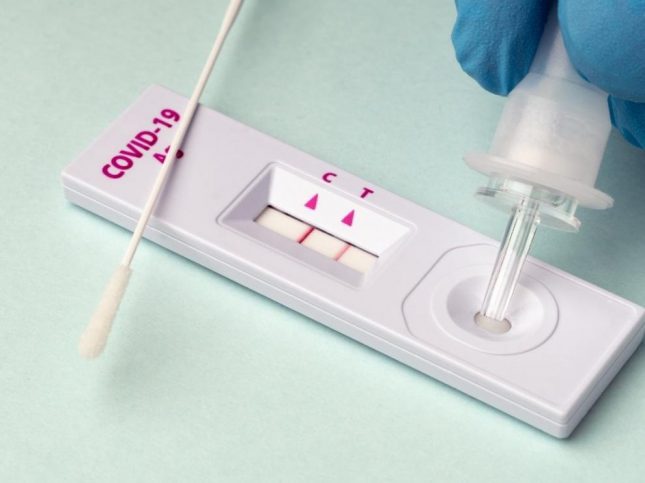
A home Covid-19 test is as good as laboratory PCR, according to a study
4 January 2022Salary tables 2021
5 January 2022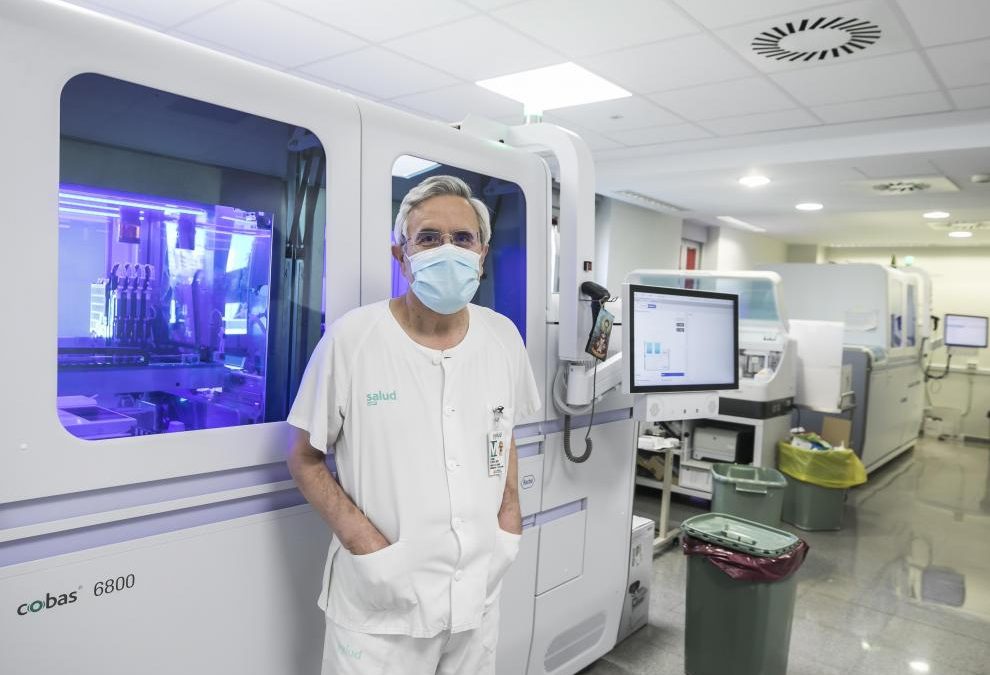
The head of Microbiology at the Miguel Servet Hospital highlights the involvement of all staff in facing a pandemic that begins the year by putting pressure on healthcare, from the emergency room to his service, in which 16.000 PCR tests have been analyzed in the last week.
The seventh wave of Covid with which Aragón receives the year keeps work in hospitals tense from the emergency room, hospital, and primary care, to laboratories. In the Microbiology service of the Miguel Servet Hospital of Zaragoza, located on the third floor of the Outpatient Consultations building, these days analyze the thousands of PCRs that are performed every day. Work volume has skyrocketed with the increase in infections, among which The omicron variant already accounts for at least 50% of cases.
The last week of the year, from Thursday to Thursday, 16.000 PCR tests were performed in this service. At times with fewer infections during the pandemic the figure stood at 2.300. "The service has had to be completely reorganized because to carry out all these tests we have needed more equipment than we previously had," says Antonio Rezusta, head of the Microbiology service. At the beginning of the pandemic it was necessary to hire more staff and obtain more equipment. "In terms of sample volume, now is the peak moment of the pandemic," he acknowledges. PCRs are analyzed in the Microbiology service.
Overload
The first year of the pandemic there were supply problems, to obtain more equipment and reagents, due to the high demand. "Now the difficulty is how to assume all the activity that is asked of us." Their desire is to get the test results within 24 hours and they had achieved this before this new wave. The overload translates into the desperation of those who wait to know the result of a test. "Their desperation, ours, stress...", she acknowledges.
Rezusta studied at the University of Zaragoza, did his residency at the Zaragoza Clinical Hospital and began working in 1987 at the San Jorge Hospital of Huesca. Born in Motos, a small municipality in Guadalajara, on the border with Aragon, he has been in the Zaragoza hospital since 2001. Throughout his career he tries to remember other critical situations, such as the first cases of HIV, influenza A or Ebola, but "there is no comparison like this". Yes, they represented some progress that has helped today. "PCRs became widespread in microbiology as a result of HIV," he recalls.
"This year the problem has been when there has been a very high part of the wave. How to respond to the needs of citizens in carrying out tests", like right now. The largest until now had been the wave of cases in September and October, until it has been surpassed by the current one, with a greater number of cases, although with less serious cases and deaths.
Defends a global strategy against the pandemic, throughout the world, and not just the current one that has begun to be implemented only "in countries that can pay for the vaccine." "Health is a global strategy," she points out. If not, he does not see it possible to stop the transmission because "the microorganisms are in people, all over the world." He is not clear how the virus will evolve, at least until "in a while." Therefore, in the year that begins he is aware that "the virus is going to be with us."
Looking to the future, he hopes that his area will continue with the progress towards a microbiology aimed at "so that the patient does not get sick", in addition to using artificial intelligence in data management.